Understanding Need-Aware & Need-Blind College Admissions Policies

Last updated June 22, 2026

In this article

Before applying to colleges and universities, it’s important to know that some schools have different policies when it comes to taking a student’s financial information into consideration during admissions. To help you understand what these policies are, known as need-blind and need-aware, we break them down for you!

How do colleges determine financial need?

Colleges access students’ financial information through the Free Application for Federal Student Aid (FAFSA)state aid application, or the CSS Profile. On these applications, you will list your family’s size, income, and asset information to help the federal government and your college determine the right amount of aid for you. Regardless of your family’s financial situation, we highly recommend completing the FAFSA or your state’s application to receive the most amount of financial aid possible for college! 

Need-blind

A need-blind admissions policy means that colleges will not take a student’s financial situation into consideration when making an admissions decision. There are a little over 100 colleges in the U.S. that have need-blind admissions policies. Need-blind colleges are typically elite schools that have the financial means to approach admissions in this way. Examples of need-blind colleges include Harvard University and Brown University. 

It’s important to know that just because a college has a need-blind admission policy, it does not mean they will automatically give you a financial aid package that covers all of your costs. Need-blind is only for admissions purposes. 

Need-aware

Need-aware means that colleges may or will take a student’s financial information into consideration when making an admissions decision. Every college handles this differently. A need-aware admissions policy can make a difference for students whose application may not be as competitive. If a school has this policy, a student’s financial need might be taken into consideration for an admissions decision.

Meeting financial need

Now that you know the difference between need-blind and need-aware admissions, be sure to research the financial aid policies of schools you’re interested in before applying. If a college says they will “meet demonstrated financial need,” it means that they’ll ensure your financial aid package reflects your demonstrated need. 

For example, if the total cost of attendance for a school is $20k per year, and the school determines that your family can contribute $5k to your education, it will offer you a financial aid package that makes up for that needed $15k. For example, the Husky Promise at the University of Washington guarantees that full tuition and fees will be covered by grants or scholarships for income eligible Washington state students. 

If you are set on attending a specific college but have some concerns about affording it, be sure to apply for scholarships early to help offset any educational costs that may not be covered by financial aid. 

Financial questions to consider when researching colleges 

  • What is this school’s admissions policy concerning financial need?
  • Does this college meet full financial need? 
  • What financial aid options are available to students?
  • Does this college award merit and need-based aid and scholarships? 

Strategies to maximize your financial aid

  • Apply to a mix of need-blind and need-aware schools. 
  • Research promise programs in your area to see if any colleges near you offer free or reduced tuition programs. 
  • Apply for different forms of financial aid (FAFSA, state aid, CSS Profile, and scholarships).
  • Apply to scholarships year-round!  

Do you have any questions about applying to or attending college? Connect with a Get Schooled Advisor.

Keep going

How to Find an LGBTQ-Friendly College or University

Last updated September 16, 2025

In this article

When researching colleges, it’s important to consider factors beyond academic offerings and financial fit. While college is a time for you to pursue your education, it’s also an opportunity to freely explore your identity, values, and beliefs as you connect with individuals who bring different perspectives, cultures, and experiences. This is particularly important for LGBTQ students, who often face unique challenges in addition to navigating college for the first time.

The good news is that many colleges and universities are recognizing the importance of inclusivity and are expanding their practices to better support LGBTQ students. So whether you identify as LGBTQ or you’re an ally looking for an environment that celebrates diversity, there are tools and strategies available to find a college that fosters a supportive community. In this article, we’ll give you some tips on how to search for LGBTQ-friendly colleges.

(Lee este artículo en español aquí!)

How to Find an LGBTQ-Friendly College or University

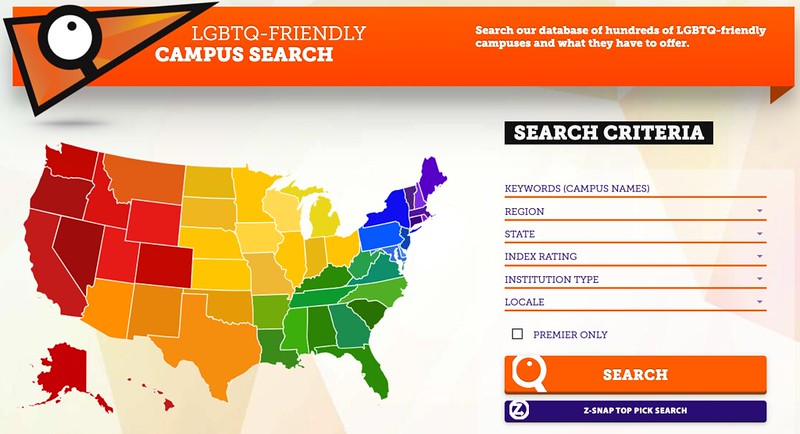
There are a few tools and strategies to help you get started. Online resources like Campus Pride Index offer a free and comprehensive database of LGBTQ-friendly colleges. Each college listed is ranked on a system that ranges from 1-5 stars, which reflect the college’s commitment to improving the academic environment and campus culture for LGBTQ students.

You can also explore a college or university’s website to search for LGBTQ student organizations, campus centers, and resources. Another approach is to join online student groups or forums where you can engage with current students or alumni who identify as LGBTQ. Their perspectives can provide invaluable insights, helping you make an informed decision about which college will best fit your needs.

Screenshot of the Campus Pride index search database - How to Find an LGBTQ-Friendly College or University

Factors to Consider

When looking for LGBTQ-friendly colleges or universities, consider the following factors:

Availability of LGBTQ Student Clubs and Organizations

Look for the availability of LGBTQ clubs and organizations, as they can offer a safe and supportive space for LGBTQ students within the larger college community. These clubs offer a chance to connect with other students who share similar experiences and can lend their support as you navigate through your college journey.

It’s also important to keep an eye out for campus centers or physical spaces where LGBTQ students can study, socialize, or access staff and faculty who can provide resources specifically for LGBTQ students. These student clubs and campus centers can help you find a sense of belonging and encourage you to participate in activism and inspire social change.

Inclusivity Policies, Programs, and Initiatives for LGBTQ Students

A college’s student code of conduct is a set of rules and guidelines that students are expected to follow, outlining expectations for behavior and conduct while on campus. Look for a college or university that explicitly states in its student code of conduct that discrimination or mistreatment against LGBTQ students is not allowed or tolerated. This shows that the college is dedicated to fostering an LGBTQ-friendly environment where all students are respected and valued.

It’s also important to look for campus initiatives that aim to improve the lives of LGBTQ students. One example is the availability of inclusive campus facilities, like gender-inclusive housing or gender-inclusive restrooms. Another example is gender affirming healthcare or counseling services for LGBTQ students, with knowledgeable providers who understand their unique needs. 

LGBTQ Representation in Academic Programs

In addition to the campus culture, also consider the college’s academic environment to determine if it is LGBTQ-inclusive. Look for LGBTQ faculty members and explore the course catalog for majors or courses exploring LGBTQ themes, like gender studies or women’s studies. Subjects like sociology, psychology, history, and political science may also offer LGBTQ-focused courses. Even if you don’t plan on majoring in these subjects or taking these classes, their existence shows that LGBTQ research is valued at that college. These departments may also provide information about internships and scholarships available to LGBTQ students.

Researching colleges can be an overwhelming process, and no school will be perfect or meet every expectation. But with intentional research, you will get closer to finding a school that best aligns with your values. You deserve to be in a college environment where you feel safe, respected, and celebrated for who you are!

Do you have any questions about building your college list? Connect with a Get Schooled Advisor.

Keep going

For-Profit Colleges: What to Know & Why to Avoid Them

Last updated June 17, 2026

In this article

As you begin to research schools and build your college list, you will notice that there’s many types of schools, education, and degrees. In your research, you may notice that some schools are for-profit, while others are nonprofit. But what do these terms mean and how do they work? Here are some important things you should know about for-profit colleges and why you should consider avoiding them. 

(Lee este artículo en español aquí!)

Empty auditorium with lights dimmed - For-Profit Colleges: What to Know & Why to Avoid Them

What is a for-profit college?

For-profit colleges are typically exactly what they sound like – profit-driven schools that prioritize making money from students. These types of schools are run like businesses and are mainly funded by private investors. Money made through student tuition and fees is largely given back to investors as profit and used on marketing and advertising to draw in more students. Examples of for-profit colleges include schools like DeVry University, University of Phoenix, and Grand Canyon University. 

How are these colleges different from nonprofit colleges?

In contrast to for-profit colleges, nonprofit colleges are typically what students think of when they think about college. In the U.S., public universities, private universities, and community colleges are most commonly nonprofit schools, meaning they’re funded by both federal and state governments, endowments, donations, and student tuition fees. Nonprofit colleges typically prioritize the quality of education and students over profits. 

Other differences:

Accreditation

Accreditation is a review colleges and universities go through by accreditors to ensure their academic programs and offerings are high-quality and up to standard. There are two main types of accreditation in the U.S. – regional and national. The most common type of accreditation is regional – most nonprofit colleges and universities in the U.S. are accredited by one of seven regional accreditation organizations. Regional accreditors typically have much more rigorous standards than national accreditors, and must be recognized by the Council for Higher Education Accreditation (CHEA) and/or the U.S. Department of Education. 

While some for-profit colleges are regionally accredited, many more are nationally accredited. This means that they have typically gone through a less rigorous review process. This may also point to a difference in the quality of education you might receive. 

If you want to know whether a school you’re interested in is regionally or nationally accredited, we recommend looking it up using the U.S. Department of Education’s Database of Accredited Postsecondary Institutions and Programs. Just type in the name of a school to begin. 

Types of degrees, specializations, and certifications

While some for-profit colleges (like Grand Canyon University) offer bachelor’s and master’s degrees, many focus primarily on technical, trade, and vocational certification and training programs. Many nonprofit trade/vocational schools and community colleges offer these types of certifications as well, but a large majority of them also offer associate and bachelor’s degrees

Acceptance rates

Because for-profit colleges need student tuition fees to make money, they typically have very high acceptance rates and low barriers for entry. Nonprofit colleges have varying acceptance rates, but typically have more rigorous requirements for acceptance. 

Graduation rates

Despite acceptance rates being higher at for-profit colleges, nonprofit colleges have higher graduation rates

Services offered to students

Because for-profit colleges need to make a return on their investment, a majority of student tuition fees go directly back to investors rather than to students. This means that they are much less likely to offer student support services, academic resources, clubs, or sports. On the other hand, nonprofit colleges make a student’s overall college experience a priority, investing time, money, and resources into student life and support services. 

Reasons to avoid for-profit colleges

As you research your college options and start to think about what schools you’ll apply to, it’s important to keep in mind that there are many reasons to avoid these types of colleges altogether. Here are just a few: 

They have a track record of misleading students

In 2021, the U.S. Department of Education announced that it would grant $1.5 billion in loan forgiveness to 115,000 students who previously attended ITT Tech, a for-profit college. Before closing in 2016, ITT Tech “misled students into taking out unaffordable private loans that were allegedly portrayed as grant aid” to continue operating. 

Notable differences in price and financial aid offerings

There are three notable financial differences between for-profit and nonprofit colleges:

Cost of tuition. For-profit colleges are typically much more expensive than public nonprofit colleges. They are typically less expensive than private nonprofit colleges. 

As of 2024, average tuition and fees at for-profit colleges were $15,868 annually. In comparison, tuition and fees were $9,750 at public in-state four-year colleges and $3,885 at public two-year colleges. 

Source: Education Data Initiative

Financial aid offerings. Depending on the type of accreditation a school has, a student’s financial aid options may be limited. For example, schools that have no accreditation whatsoever are not eligible for federal financial aid such as the Pell Grant or student loans. Inability to complete the FAFSA and receive federal aid also restricts a student’s scholarship options, since most organizations that award scholarships require applicants to complete the FAFSA first. Additionally, since nonprofit schools have more support systems in place for students, they are much more likely to offer institutional aid like scholarships to their students, which can significantly cut tuition costs. 

Debt levels after graduating. According to College Board (page 44) “Students who earn their bachelor’s degrees at for-profit institutions … are more likely to borrow and accumulate higher average levels of debt than those who graduate from public and private nonprofit four-year colleges.”

Difficulty transferring

Transferring from a for-profit college to a nonprofit college may present some difficulties to students. This is largely due to a school’s accreditation. For example, if a student attends a college that isn’t accredited, it’s highly unlikely that any of their credits will transfer to a nonprofit college. Similarly, if a student transfers from a for-profit college that has national accreditation rather than regional, it’s also unlikely that a majority of their credits will transfer. In both cases, this means that a student would have spent time and money on credits that can’t be used toward their degree. 

Reasons to consider a nonprofit college

With all of this in mind, here are some reasons we highly recommend students consider attending nonprofit colleges:

  • Higher-quality education. Because nonprofit colleges typically have regional accreditation, the quality of education is likely to be much higher.
  • A student’s overall college experience is prioritized. Because nonprofit colleges typically have more funding for student support services and extracurriculars, they are more likely to provide a better overall college experience.
  • Price. Nonprofit colleges are, in many cases, significantly less expensive than for-profit colleges. This is especially true at public colleges. A large majority of for-profit colleges offer specialized trade, technical, and vocational training–but with a high price tag. Compare this to nonprofit two-year colleges and trade schools, which offer the same exact types of training for significantly less money. 

Making a decision about where to attend college can be intimidating, but we’re here to support! If you have any questions about making your college decision, connect with a Get Schooled Advisor. 

Keep going

College Visits: 7 Things to Do

Last updated September 18, 2025

In this article

College visits are much more than a campus tour! They’re an opportunity to get a feel for the overall experience a college offers its students and whether you can picture yourself thriving in its community. In this article, we’ll share 7 things you can do to make the most of your college visits! 

Explore academic programs 

If a college offers majors or programs that interest you, try making an appointment with a professor or advisor in those departments to learn more. They can offer some insight into the required coursework, classes that students love, and what alumni have done professionally after graduating. They can also potentially connect you with current students in that program to learn more about their experience. Having an idea of whether that college can give you the academic experience you’re looking for early on can help you decide if you want to apply there when it’s time! Learn more about choosing a college major. 

Additionally, if possible, you can also request to sit in on a class or lecture in a major that interests you. This can help you familiarize yourself with educators in that department and learn more about class sizes at a college. 

Explore the surrounding community

If you have any free time during your visit, check out the college’s surrounding community and what it has to offer. Try heading to a restaurant, coffee shop, or park to help you consider whether the area feels like a place you’d enjoy living for the next few years. You can also try to learn more about the public transportation in the area and how convenient it is to get to places from campus. 

Explore housing options

If you plan to live on campus your freshman year, try touring a residence hall. You can ask RAs or tour guides about different housing options on campus and their general costs. You can also learn more about any amenities offered in dorms, such as dining halls or laundry facilities. 

Get a feel for the campus culture

Campus culture plays a significant role in a student’s college experience! Choosing a college whose culture aligns with your values, provides opportunities for you to de-stress and have fun, and makes you feel safe and supported is key. On your college visit, check out campus hangout spots and student spaces to get a feel for a day in the life of a student there. 

Visit admissions and financial aid

During college visits, students will typically learn about the application and financial aid processes. If you want to learn more, you can head to the admissions and financial aid offices to speak with someone and ask any questions you may have! You can ask about what makes a stand-out application at that school, tips for completing financial aid forms such as the FAFSA, and more. 

Talk to students

During your college visit, try asking a current student about their experience at that school. You can ask things like: 

  • What are the pros and cons of attending school here?
  • What are some clubs and events on or around campus that students love? 
  • How does this school respond to social and political events?
  • How does this school take care of its students?
  • Where are the best study and food spots?

Hearing about a college straight from current students can help you decide whether it would be a good fit for you!

Take notes

Document your experience on campus by taking notes about what you’ve learned, any pros and cons, and whether you can see yourself attending and thriving at that school. These notes will definitely come in handy as you start to work on your college applications! 

Click the button below to download our college tour note sheet and keep all your thoughts, notes, and questions organized! 

Do you have any questions about college visits? Connect with a Get Schooled Advisor.

Keep going

Exploring a College From Afar

Last updated September 16, 2025

In this article

There are many great ways to tour a college and get a feel of its campus, culture, and academics from the comfort of your own home. Here are some ways you can learn more about prospective colleges to help you make a decision about where to apply.

Virtual tours

If you’re interested in learning more about the layout of a school’s campus, virtual tours are a great option. Virtual tours are videos, slideshows, and sometimes even interactive 3D experiences walking you through the entire campus!

  • Appily offers free virtual tours of many campuses. 
  • CampusReel.org has short student-made clips of their campuses.
  • CampusTours has interactive campus maps.
  • Princeton Review has a table of colleges and universities with virtual alternatives to on-campus tours sorted by state.
  • Visit a prospective college’s YouTube or admissions page for additional resources.

Visit admissions office hours or info sessions

Curious about academic programs or want to get connected to alumni or current students at a college you’re considering attending? At many colleges, the admissions office schedules virtual “office hours” to answer prospective students’ questions. Check a school’s admissions page to learn more.

Use social media

Most colleges have active Facebook groups for prospective classes. Search “[The college you’re interested in] class of 2028” and you’ll find them! Students are candid, informative, and supportive in these groups. As an added bonus, they’re usually moderated by alumni or current upperclassmen.

TikTok and YouTube are also great tools to explore colleges! Use the search bar and hashtags to view videos about the college you’re interested in attending. Some students will post “day in the life” videos where you can get an idea of what it’s like to be a student on campus. They may even answer questions in the comments section or have created an FAQ video to address popular questions they get about their college.

Keep in mind that these videos only show a particular view and their experience might not be yours, but it will help you see the campus and learn about student culture a bit more!

Do you have any questions about touring a college virtually? Connect with a Get Schooled Advisor.

Keep going

Questions To Ask Current Students At Colleges You’re Considering

Last updated September 4, 2025

In this article

As you research colleges and start to build a list of schools you’re interested in applying to, you’ll learn a lot about them– like the academic programs they offer, the resources available to students around campus, and more. But nothing beats straight from the students who live and learn there every day. 

Visiting colleges is not only a good opportunity to learn more about the schools that interest you, but to really get a feel for whether they’re a good fit for you. On your next college visit, the best way to find this out is to talk to current students there! Here are some questions to ask current students at colleges you’re considering.

Five students sit around a table and type on their computers - Questions To Ask Current Students At Colleges You’re Considering

What’s it like to be a student here? Would you recommend attending this college? Why?

Pay special attention to the whyswhat they like and dislike about the college and why. Get as many perspectives as you can from as many different people you can find.

How are the academic programs and majors?

This is a key follow-up to the first question. Students majoring in different fields often have different experiences and impressions of a college. For example, a student majoring in English literature might feel fulfilled, while a student majoring in engineering might be wishing for more from their major. Asking multiple people about what they’re studying can give you a more complete idea of what it’s like to be a student at that college. 

What are your favorite and least favorite things about this college?

This question gives the students you’re chatting with the opportunity to give a fair overview of the major pros and cons of attending their college, from their perspective. Pay attention to how the things the students are labeling their favorite and least favorite match up to your own list of priorities for what you want in a potential college.

What is student life like?

Learning about student life at a college is just as important as learning about academic departments and majors! College is a place to learn new things, have new experiences, and have fun. Be sure to ask about things that typically happen on or around campus, such as sports games, concerts, special events, traditions, and more. Even if a college has everything you’re looking for academically, it may not be the best fit if there’s little to no student life or fun things happening around campus. 

Do you have any questions about choosing a college? Connect with a Get Schooled Advisor.

Keep going

College Diversity Fly-In Programs: What You Need to Know

Last updated September 3, 2025

In this article

Did you know that some colleges and universities offer free travel and tours for prospective students? These programs, known as diversity fly-in programs, are designed to make college tours more accessible for low-income, first-generation, and minority students. Here’s what you need to know about these programs and where to find them!

(Lee este artículo en español aquí!)

Image of 3 friends jumping in the air and smiling - College Diversity Fly-In Programs: What You Need to Know

What are diversity fly-in programs?

Diversity fly-in programs make intentional space for low-income, first-generation, and minority high school students to explore their college options. These programs offer both prospective and admitted students all-expenses-paid tours of their campuses to get a feel for the college experience. They’re typically held in the spring and summer of a student’s junior year or in the fall of their senior year.

What’s their purpose?

These programs offer many things to prospective students! On a college trip through a diversity fly-in program, students can learn more about a school’s student experience, ask questions to current students and faculty, explore majors, and gain a deeper understanding of what they do and don’t want from the college they attend.

Who can apply?

While eligibility requirements will vary by school and program, they are usually designed primarily for first-generation, low-income, and minority students.

Where can I find more information?

To find diversity fly-in programs and learn how to apply, check out these lists:

You can also search for diversity fly-in programs on Google by searching things like:

  • ‘[Name of school] diversity fly-in programs 2025’
  • ‘Diversity fly-in programs for high school seniors’
  • ‘Diversity fly-in programs 2025’

Do you have any questions about diversity fly-in programs or getting to college? Connect with a Get Schooled Advisor.

Keep going

4 College Application Deadlines You Should Know About

Last updated December 3, 2025

In this article

With many college applications (like the Common App) opening on August 1, you’re probably wondering when the best time to submit yours is. While the colleges you’re applying to will list their deadlines on their websites, it can be helpful to be aware of the four main types of application deadlines to understand your options. We break these deadlines down for you!

(Lee este artículo en español aquí!)

Early Decision and Early Action

Under early decision (ED) and early action (EA), you can apply to a college by an earlier deadline, usually in November of your senior year of high school, and receive a decision on your application in December or January. If applying under ED or EA, you may have a higher chance of getting accepted when you match or exceed the college’s acceptance requirements. 

Early Decision (ED)

If you are sure where you want to attend college, match or exceed the college’s admissions requirements, and are confident that you have or can receive the financial support necessary to attend, applying through early decision may be right for you. It’s important to note that unlike the other college application deadlines, ED is binding. This means that if you are accepted to a school through ED, you must withdraw all other applications you’ve already submitted through regular decision and agree to attend that school (unless your financial aid award is insufficient). Through ED, your nonrefundable enrollment deposit must also be sent relatively soon after you get accepted, usually in January. Specific deadlines for enrollment deposits will vary by school. 

Early Action (EA)

Applying through early action is an alternative to early decision if you want to hear back from your top schools sooner, but still want to wait for admissions decisions from other colleges you applied to under different deadlines. Under EA:

  • Your application can be accepted, denied, or in some cases, deferred, meaning your application will be reviewed and considered on the same timeline as regular admissions. This means you’d receive an admissions decision later, around March or April.
  • You can submit other college applications under regular admission and early action. However, a few schools have restrictive or single-choice EA, meaning that you are unable to apply to private schools through under their EA deadlines. (You are allowed to apply to public universities through EA.) Be sure to do your research before applying. 
  • Applications are non-binding, so you can consider other acceptance offers or decline the school’s admissions offer for any reason.
  • You can wait to hear from other colleges you applied to and compare your financial aid award offers to make the best college decision for you. 

The Limitations of Early Decision and Early Action

While ED and EA have their benefits, make sure you consider the limitations of applying under these programs:

  • Under ED and EA, your college application timeline will be pushed earlier, typically by a few months. For example, if you are taking the SAT or ACT, you will need to register for an earlier test date (by October) for test scores to be submitted on time. You will also need to have your essays, transcripts, letters of recommendation, and other application materials ready to submit before the early deadline.
  • You typically have to commit to one college if applying under ED or single-choice/restrictive EA, which can feel like a lot of pressure to make the right choice of school. Make sure you talk to a trusted educator or adult to go over all your options before deciding to apply under ED or single-choice/restrictive EA.
  • Your financial aid options may be limited. If you are accepted to a school through ED, you will likely not have a chance to compare your financial aid offer letter with those of any other schools.

Regular Decision

A majority of students apply to college under regular decision deadlines, which are usually in January or February of your senior year. Colleges send their decisions in March or April, and you will have until May 1 to make a decision. Regular decision has the widest application window, which gives you more time to gather your application materials.

A young woman with curly hair holds a book to her chest in a library and smiles at the camera - 4 College Application Deadlines You Should Know About

Rolling Admission

Some colleges have rolling admission, meaning that they accept and review applications as they are received until all spots in a given class year are filled. This means that you can apply to college later in the school year and still have a chance of getting accepted! Different colleges will have different time frames of when you can submit your application and how long it will take to hear back from them. Check in with each school you’re interested in applying to for specific dates and deadlines. Colleges with rolling admission may also be a great option for students to make decisions about enrollment based on aid. 

After You Submit Your Application

No matter where or when you submit your college applications, be sure to check your email and mailbox regularly since the majority of colleges will send their decisions in one of these ways. They may also reach out if your application is incomplete or even request additional information, such as a letter of recommendation, resume, or supplemental essays to get to know you better as they are reviewing your application. If you receive any requests like this, it’s important to respond ASAP.

Do you have any questions about applying to college? Connect with a Get Schooled Advisor.

Keep going

How to Research Schools & Build Your College List

Last updated September 3, 2025

In this article

With so many college options to choose from, it’s important to develop a strategy to narrow down your choices. Building a college list allows you to compare your options to make an informed decision about where to apply. Making decisions during the college application process can feel overwhelming, but we’re here to help! Follow the tips below to research schools and build your college list.

(Lee este artículo en español aquí!)

Decide what’s most important to you

Everyone’s goals and interests are unique, so it’s important to identify what matters to you when researching colleges. Take a moment to reflect on your priorities and be honest with yourself–what your family wants in a school may not necessarily align with what you want. This is a great opportunity to get to know yourself better to consider what you want from your college experience.

For example, here are some things to consider as you reflect on your ideal college:

  • Think about the location of the college. Do you plan to live at home? Do you want to live on campus but be within a few hours from home? Does going to a school in a different state sound like the best option for you?
  • How do extracurricular activities, like clubs or sports, factor into your decision?
  • Make sure to research the size of the school and its classes. Do you want a small professor to student ratio? Is a bigger school with bigger class sizes more ideal?
  • Is it important for your school to share your religious and/or social awareness values? How much will these requirements weigh on your decision to apply?

Read more for information on some of these factors and how they can impact your college experience:

Use the right search tools

To begin your research, we recommend using three resources. The U.S. Department of Education’s College Scorecard tool and College Board’s BigFuture platform both provide information about colleges’ graduation rates, average annual costs, and student body demographics. If financial fit is a priority for you, uAspire’s list of financially safer schools can also help in your search.

If you have specific schools in mind, use their websites to research academic factors like majors or minors offered, classes offered and their descriptions, and professor profiles. To get a better sense of the college’s culture, values, and community, you can also follow their social media accounts to see what’s happening on and around campus. Using these tools will allow you to get a full picture of each college before deciding where to apply.

Organize your list and keep it manageable

When you begin your college search, you may already have a long list of schools–and that’s okay! It’s completely normal to start with a list of 20-30 colleges that meet your criteria before narrowing it down as you go deeper into your research. Once you have your list, categorize them into reach, match, and solid schools:

  • Reach schools are the ones you dream of going to, but are a bit more competitive to get into due to things like lower acceptance rates, minimum required GPAs or test scores, or even high costs of tuition.
  • Match schools are schools you feel confident about getting accepted to, even if they’re not necessarily at the very top of your list.
  • Solid schools are ones you have a strong chance of getting admitted to. Your test scores, GPA, or coursework typically match those of other incoming students at these schools.

Once everything is categorized, consider narrowing your list down to 10-15 colleges, with a few schools in each category to keep your options open. Organizing your list and keeping it manageable will help you stay on top of your applications and make the college search process less overwhelming!

Time to build your list!

Ready to start building your college list? Click the button below to download our free College List Builder!

Do you have any questions about the college application process? Connect with a Get Schooled Advisor.

Keep going

Associate Degree vs Bachelor’s Degree: 5 Key Differences

Last updated June 29, 2026

In this article

As you begin to explore your post-high school options and build your college list, you’ll learn a lot about the different types of colleges and the degrees you can receive through them. All undergraduate college students typically receive either their associate or bachelor’s degree when they graduate. But what are those degrees and how are they different? We’ll break down four key differences between associate and bachelor’s degrees to help you understand your college options and make an informed decision about the type of college you want to attend!

(Lee este artículo en español aquí!)

What is an associate degree? What is a bachelor’s degree?

An associate degree is an undergraduate degree that is a level above a high school diploma or GED and a level below a bachelor’s degree.

A bachelor’s degree is an undergraduate degree that is a level above an associate degree.

Types of associate and bachelor’s degrees

While the types of associate degrees offered will vary by college, the three most common are: 

  • Associate of Arts (AA)
  • Associate of Science (AS)
  • Associate of Applied Science (AAS)

While the types of bachelor’s degrees offered will vary by college, the two most common are: 

  • Bachelor of Arts (BA)
  • Bachelor of Science (BS)

Different subjects and majors can fall under different types of degree categories depending on the school (e.g. a psychology degree might be a BA at one school but a BS at others), so be sure to check in with the schools you’re interested in to learn more.

Associate degree vs bachelor’s degree: 5 key differences

Types of colleges and time spent in school

Associate: Students typically receive their associate degree from a two-year college, also known as a community college. Most community colleges only offer associate degree programs. However, students can continue their education by transferring to a four-year college to receive their bachelor’s degree.

Bachelor’s: Students typically receive their bachelor’s degree from a four-year college or university. You can earn a bachelor’s degree at some community colleges, but the availability of these programs vary.

Credit requirements

Associate: Associate degrees are awarded to students who have completed anywhere from 60-90 credits, depending on the credit requirements and term structure (quarter or semester) of the college they attend.

Bachelor’s: Bachelor’s degrees are awarded to students who have completed anywhere from 120-180 credits, depending on the credit requirements and term structure (quarter or semester) of the college they attend.

Cost

In general, associate degrees are much less expensive to get because the cost of tuition at community colleges is typically cheaper than at four-year colleges. Also, because an associate degree usually requires less credits than a bachelor’s degree, it may be a more affordable and efficient option over time. 

Here’s a breakdown of average college costs (including tuition, room and board, etc.) during the 2025-2026 school year:

  • Two-year public college: $15,000
  • Four-year public college in-state: $25,850
  • Four-year public college out-of-state: $45,780 
  • Four-year private college: $60,920

Source: College Board (page 10)

While it may be overwhelming to read those numbers, don’t panic! They are a rough national average; different schools will cost different amounts. There are also millions of dollars available in financial aid for college students (like scholarships, grants, and loans) to help lower the cost.  

College is expensive, but don’t limit yourself or your academic options if you’re unsure of how to pay for school. We recommend talking to a trusted adult or educator to weigh your college and financial aid options and make a decision that will work best for you long-term.

Flexibility

Associate: Associate degree programs are often designed with flexibility in mind, making them ideal for students who need to balance school with other responsibilities like work or family. Many community colleges offer part-time options, online courses, or evening classes to accommodate many different learners.

Bachelor’s: Bachelor’s degree programs, while also offering flexibility at some colleges, generally require a greater time commitment and may have fewer options for non-traditional schedules. Full-time, in-person attendance is often emphasized at four-year colleges and universities. However, more online and hybrid bachelor’s programs are becoming available across the country.

Career prospects and average earnings

While there are many different career paths a student can take with both an associate and bachelor’s degree, certain professions may require certain types of degrees and certifications.

For example, many community colleges and trade schools offer specialized training to enter into professions such as carpentry, plumbing, cosmetology, and more. In order to start working in one of these professions, workers typically must have formal training and a degree (usually an associate) or certification in those specialized fields. If you want to become a cosmetologist, for example, you must first attend cosmetology school (a kind of trade school or a program offered through a community college), then receive your certification, associate degree, or license, and lastly, find work in your specialized skill.

On the other hand, other professions almost always require a bachelor’s degree. For example, if you want to become a college professor one day, you must first receive your bachelor’s degree so that you can continue on to receive your master’s degree and PhD (the degree usually required for this kind of profession).

Another important consideration is average earnings for both types of degree holders. According to the U.S. Bureau of Labor Statistics, “Education boosts earnings and reduces unemployment.” Bachelor’s degree holders typically have higher long-term earning potential than associate degree holders in the U.S; in 2024, they on average earned nearly $1,776 more dollars per month. That means at least $21,312 more per year!

Even with all of this in mind, it’s important to know that these statistics are not one-size-fits-all. There may always be some flexibility to attain jobs or high earnings long-term. Just because you receive an associate degree doesn’t mean you are guaranteed to earn less than someone with a bachelor’s degree, or vice versa. When you search for jobs after receiving your degree, there can always be flexibility as long as you have the right skills and experience in the career paths that interest you.

Two people sit and look at a computer screen - Associate Degree vs Bachelor’s Degree: 5 Key Differences

What’s next?

Regardless of the path you take, it’s a good idea to take some time to consider these things now to help you make an informed decision about your college choice and career opportunities. Not sure where or how to start your journey? Explore here!

Do you have any questions about associate and bachelor’s degrees? Connect with a Get Schooled Advisor.

Keep going