What’s The Difference Between A College & University?

Last updated November 3, 2025

In this article

As you begin to research schools and build your college list, you may be wondering about the difference between a college and university—and which may be a better fit for you. Although many people use these terms interchangeably, there are some slight differences between the two. In this article, we’ll break down some key distinctions and similarities between colleges and universities to help with your research!

What’s the difference between a college & university?

School & degree types

One main difference between colleges and universities is the highest level of degree they offer. In the U.S., there are two main types of colleges: community colleges and four-year colleges. Community colleges offer associate degrees, which take about two years to complete. Four-year colleges and universities, on the other hand, offer bachelor’s degrees, which usually take four years to complete when enrolled full-time.

In addition to bachelor’s degrees, universities also offer graduate programs, including master’s degrees and PhDs. Colleges usually focus on undergraduate programs and less commonly offer graduate degrees compared to universities. This probably won’t impact your undergraduate college research, but it could be helpful to know! 

Size

While colleges and universities vary in size across the country, universities (especially public ones) typically have bigger campuses and class sizes.

Similarities between colleges & universities

There are more similarities between colleges and universities than you might think! Learn more:

Admissions processes

Regardless of where you apply, the admissions processes will likely be similar. Both types of schools may accept the Common App and require application and supplemental essays, academic records, and information about extracurricular activities. Be sure you’re aware of each school’s application requirements, though, since they can vary.

Price

The type of school that’s most likely to cost the least in tuition and fees is community colleges. Four-year colleges and universities vary in cost, and neither is consistently more expensive than the other. No matter where you attend, financial aid may be available to help reduce college costs.  

Private vs. public 

Both colleges and universities can be private or public. Public schools are usually larger, have state funding, and are more affordable for in-state students. Private schools may be smaller and more expensive. 

Colleges within universities

While you research schools, you may see that some universities have “colleges” within them. Confusing, we know! In these cases, college doesn’t refer to a completely separate school, but a program within the university that focuses on a specific subject or area of study. For example, New York University (NYU) has multiple colleges within its system. These colleges offer majors and programs for students on a specific academic path, like arts, business, and medicine. 

There are many ways to get a great education! What matters most is choosing a school that supports your academic and professional goals. A college degree of any kind can expand your mind, positively impact your lifelong earning potential, help you make connections and friends, and come closer to identifying careers that interest you. Regardless of where you want to attend, you belong in college

Do you have any questions about preparing for college or the differences between colleges and universities? Connect with a Get Schooled Advisor.

Keep going

The Financial & Professional Benefits of a College Degree

Last updated June 18, 2026

In this article

It’s totally reasonable to question whether college is worth the financial investment as tuition prices across the U.S. continue to increase and the job market remains unpredictable. While these are real concerns, it’s also important to consider just how many great financial and professional benefits there are to obtaining a college degree! We share just a few below.

(Lee este artículo en español aquí!)

Graph of BLS 2024 weekly median earnings statistics - The Financial & Professional Benefits of a College Degree

Source: Bureau of Labor Statistics

Higher lifetime earnings

Whether you choose to work toward an associate or bachelor’s degree or earn a certification through a trade or technical program, a college education boosts earnings and reduces unemployment in the long run. According to the Bureau of Labor Statistics, bachelor’s degree holders typically have higher long-term earning potential than those with a high school diploma. In 2024, they on average earned nearly $2,452 more dollars permonth–at least $29,424 more per year!

More job opportunities

With a college degree, you are more likely to be considered for higher-level positions and higher-paying jobs than someone without a degree. In a competitive job market, your degree shows that you have a deep understanding of your chosen area of study. Additionally, many industries may require degrees or certifications as a minimum qualification for entry. For example, if you are interested in being a cosmetologist or want to be a high school teacher, you will be required to have technical training and/or at least a bachelor’s degree.

Access to more resources

Attending college gives you access to many professional resources that can benefit you both while you’re still in school and after you graduate. For example, the career center can teach you how to draft a solid resume and cover letterfind a job or internship, prepare for interviews, build your professional network, and will give you access to your school’s job portal, which can connect you to employers and mentorship opportunities near you. The resources offered through a college’s career center are typically free to use, so we highly encourage you take advantage of them!

Grow your professional network

College is a great place to start building your professional network. Professors and advisors can offer you guidance as you navigate career paths related to your major and connect you to professionals in that field to add to your network or hold an informational interview with. Additionally, your college community, such as your friends, classmates, club advisors, and coaches can be a part of your network as well! Your professional network can be key in helping you secure job references and finding professional opportunities, and college is a great place to start establishing it. 

Is going to college worth it?

Overall, yes! Attending college will only open you up to many financial and professional opportunities in the future. However, we know that the cost of college plays a significant role in whether a student will attend. Fortunately, there are many forms of financial aid available to college students–like scholarships, grants, and loans–that can significantly decrease costs. 

As you begin to research colleges that are a good financial fit, check out uAspire’s list of financially safer colleges, a list of both public and private universities that offer better financial outcomes to its students in terms of cost, net price, debt and repayment rates, and graduation rates. Having options to choose from can help you select a college that’s financially realistic for your and your family’s financial situation. 

The cost of going to college can be intimidating, but earning a college degree is a smart investment into your future. If you have any questions, we’re here for you! Connect with a Get Schooled Advisor.

Keep going

Non-Financial Reasons to Attend College

Last updated March 3, 2026

In this article

When considering your post-high school options, it’s completely normal to wonder if attending college is worth the time, money, and effort. Attending college is a significant step for students, so it’s important to be aware of the facts and potential short- and long-term impacts of your decision. 

While there are many financial and professional benefits of receiving a degree, there are lots of other important benefits not as commonly talked about! In this article, we’ll explore some common non-financial benefits of attending college—including personal experiences from the Get Schooled team! 

Personal growth and exploration

College creates time and space for self-discovery in lots of different ways. You’ll meet people from all over the world from different cultural and personal backgrounds. Simply being exposed to new people, perspectives, and experiences can help you learn and try new things. This kind of exposure isn’t just a bonus for your college experience—it’s essential to becoming a curious, open-minded, and thoughtful young person. 

Most colleges also provide structured opportunities for personal growth and self-exploration through:

  • Extracurricular activities. Colleges are filled with clubs, sports, and cultural groups for students who want to try new things. Whether you play intramural soccer, volunteer at your school’s radio station, or join the Black Student Union, you can be exposed to new people, ideas, and beliefs. 
  • Classes. You may choose to take a new class that challenges your beliefs, expands your mind, or ignites a new interest in a topic or major you didn’t previously know about. 
  • Studying abroad. Many students choose to study abroad to learn about different cultures and traditions. Through food, landscapes, and the people you meet, you can learn a lot about yourself and others. This is a great opportunity for personal and intellectual development! 

Here are some experiences from the Get Schooled team about how extracurriculars expanded their points of view:

“I would say my sorority helped me to travel. Our conferences were in different states, so that gave me the confidence to solo and group travel. I was able to go to different events and gatherings every year throughout the U.S. Although I didn’t get to travel abroad during college like I wanted to, this helped me see a new way of traveling.” -Mariela R. 

“In the LGBT Studies course I took, I learned more about the queer community, specifically the trans community, and what they go through to fit in. This gave me the opportunity to be educated and be a better friend to the people I’d meet in the future. Through the people I met in the course, I was able to help a homeless friend get a bed at a queer shelter in West Hollywood.” -Yesi C.

Personal connections

The people you meet in college can change your life in a number of ways! For example, you could meet lifelong friends in your dorm, classes, or extracurricular activities. You can also connect with professors or campus advisors that help you follow a certain career path, become part of your professional network, or even mentor you in the future! 

Read more about special connections members of the Get Schooled team gained in college:

“My randomly assigned freshman year roommate ended up becoming my best friend and like a sister to me. We’ve lived together, traveled the world together, and have seen each other evolve through many phases of life. I can’t imagine my life without her now, and I have our college to thank for such a valuable connection!” -Taylor M. 

“Through friends of friends in college, I met my now-wife of 6 years.” -Andre G.

Access to resources

In college, your tuition and fees cover different on-campus resources available to students. These resources may include things such as:

While these resources are available to all college students, they can be especially helpful for low-income or first-generation students who are learning about the college system for the first time. These types of resources offer very valuable knowledge and support to students! 

Skill development

In addition to the major- and career-oriented skills you’ll gain in college, you’ll also learn valuable life skills. Here are some skills that college can help you develop in a safe, supportive environment:

  • Time management and organization. Regardless of what you’re studying, you’ll need to keep your academics and extracurriculars organized to succeed. College is a great place to practice these skills!
  • Independence and responsibility. Even if you’re attending college close to home, you may gain a level of independence you haven’t experienced before. Your academic success will be almost entirely up to you and the effort you put in. Additionally, if you live off-campus, you’ll be able to learn about money management and the financial responsibilities of a young adult, such as paying for rent, utilities, transportation, and groceries.
  • Self-advocacy. Whether you need an extension on a deadline or are navigating a conflict in a campus club, practicing advocating for yourself and your needs matters. This is an essential lifelong skill that can be built through your experiences in college! 
  • Durable skills. In college, you’ll organically learn about durable skills—essential and timeless skills that will help you thrive in work, school, and life. You’ll learn how to think critically, communicate effectively, and become a leader. These skills will last you a lifetime!

The value of college goes beyond the money you could make! Your college experience can be one that’s enriching, fun, and that sets you up for a lifetime of personal and professional fulfillment. 

Do you have any questions about why attending college matters? Reach out to us! Connect with a Get Schooled Advisor.

Keep going

Four Strategies To Make Post-High School Decisions Less Intimidating

Last updated December 15, 2025

In this article

Deciding what to do after high school is an important and exciting milestone! While some people may have a clear picture of what they want to do when they graduate, others may be undecided, and that’s totally okay! While it’s normal to feel a bit overwhelmed about the options in front of you, there are some approaches and mindfulness tools to help decision-making feel less intimidating when you’re stuck.

Graduates and their loved ones walk in a grassy field - Four Strategies to Make Post-High School Decisions Less Intimidating

Plan for what you can and accept the rest

It can be easy to get caught in a cycle of overthinking or feeling anxious about committing to the “right” choice, especially when figuring out life after high school. Decision fatigue is the idea that after making many decisions, our ability to make even more decisions declines. Often, this added stress stems from a fear of uncertainty, failure, or regret. These feelings can be avoided or minimized by planning and mindfulness surrounding life after high school. Start by identifying the decision that needs to be made. Ask yourself questions like:

  • Have I talked to my family, friends, or school counselor to sort through my dreams or ideas?
  • Have I explored various information outlets about careers, education, or self-development?
  • Do I know what opportunities are available to me?
  • Have I figured out what I value or what’s important to me?
  • What makes me hesitate? What am I worried about?

It’s important not to spend time fixating on what you can’t control, and to embrace the reality that not everything planned will play out as expected. It’s helpful to remember that you are never locked into one pathway; you can change your mind and your goals at any time! If you feel yourself becoming overwhelmed with too many decisions, step away from them for a moment and practice a mindfulness activity such as journaling or meditating.

Define your goals and interests

Before you make or commit to any decision, consider what you want from your future. Research the different post-high school options so you are well informed about all parts of all your choices. Do you hope to enter the workforce and gain skills on the job, or do you want to go to college to prepare for a career? Writing out your specific goals and the things you’d like to accomplish after high school is a helpful way to avoid getting stuck in the decision-making process. Make a list of short-term and long-term goals to help you identify which pathways or opportunities align with your vision.

Having an idea of your interests and what is important to you can also make figuring out what to do after high school less intimidating. Do you have a clear picture of your current skills or talents and how you’d like to use them? Is being near your family important to you? Take the time to explore your needs and priorities. This will not only help you narrow down your decisions, but will help you feel at ease with the choices you ultimately make.

Weigh your options

Brainstorming the various pros and cons of the different directions you can go in is a useful way to visualize how closely a path may suit your needs. If there are too many decisions to consider alone, talk things over with trusted mentors, family, or educators. It’s okay to ask for help and advice if you need it!

Remember that career preparation and personal growth can happen in many different settings, so choose what’s right for you. If you take the time to plan well, you are more likely to have an easier time making decisions you’re at peace with.

Remember that there is no single “right” way to proceed

Different choices may have different trade-offs, but there is no “right” way to proceed. Try to approach decision-making in small steps, tackling one decision at a time. Make the best choice possible based on your circumstances and knowledge, then make peace with your decisions, knowing you can always change your mind. Talk with your peers or recent graduates to gain different perspectives on how others made their choices and how their lives are going after high school. This is a great way to make connections and learn about additional resources.

Do you have any questions as you weigh your post-high school options? We’re here to support! Connect with a Get Schooled Advisor.

Keep going

Thriving in High School: Exploring College Options

Last updated December 15, 2025

In this article

High school is an exciting time with lots of opportunities to grow and learn more about yourself! In this article, we’ll share some tips about exploring all your college options during high school:

Scroll down to learn more about each!

Download our free Get Accepted Guide to learn about the college application process from start to finish!

A young woman with curly brown hair sits cross-legged on the ground and balances a laptop on her legs - Thriving in High School: Exploring College Options

Talk to Your Counselor

Your college counselor is your best resource to start exploring your college options. Set up an appointment with them to ask any questions you may have about applying to and attending college. You will need to meet with your counselor often during your senior year, so now is a great time to start building a relationship with them!

Explore Different College Paths 

Here are some common college paths you can take after high school:

Four-Year College

Students attending four-year college typically earn a bachelor’s degree. Some students attend college in their home state, while others go out of state. For students who want to connect closely with their culture in college, attending a Historically Black college or university (HBCU) or Tribal College or University (TCU) may be the right fit for them.

Two-Year College

Students attending a two-year college, also known as a community college, typically earn an associate degree. After receiving an associate degree, students can transfer to a four-year college to receive their bachelor’s degree, or enter the workforce. 

Trade School

A trade is a skilled job that requires special training and education. Examples of trades are technology, cosmetology, culinary arts, and health care. Trades can be learned through trade schools or community colleges. 

Learn About the Components of College Applications 

While different colleges and universities will have different application requirements, here are some common things you can expect to submit:

Learn How to Research Colleges & Stay Organized 

Before applying to colleges, it’s important to do your research. Different colleges offer different things, so taking some time to reflect on what you want from your college experience can help you build a list of schools you want to apply to. In addition to a school’s size, location, campus culture, and academics, you can research things like:

To stay organized during your research, use our free college application requirements tracker!

Do you have any questions about thriving in high school? Connect with a Get Schooled Advisor.

Keep going

High School Diploma vs. GED: What’s The Difference?

Last updated September 16, 2025

In this article

Curious about the differences between a high school diploma and a GED? Whether you’re still in school or thinking about going back, understanding your options is the first step to planning your future. In this article, we break down the differences between a high school diploma and a GED. 

A person wearing a black robe with red trim holds their diploma - High School Diploma vs. GED: What's The Difference?

What is a high school diploma?

A high school diploma is a certificate students earn once they successfully complete all required courses and credits from 9th-12th grade. Once a student has received their high school diploma, they can continue in their education and attend college, trade/vocational school, or enter the workforce. (Learn more about the different post-high school paths you can take.) A large majority of youth in the U.S. graduate high school and receive their high school diploma. 

What is a GED?

The GED (General Educational Development Test) is an alternative to a high school diploma for students who didn’t finish high school but still want to receive a credential that proves they have a high school-level education. To receive their GED, students must pass a series of tests in four subjects:

  • Mathematical Reasoning
  • Reasoning Through Language Arts
  • Science
  • Social Studies

(Source: GED)

A GED is a great alternative for students who were/are unable to receive their high school diploma for personal or family reasons. 

How are they similar? How are they different?

Both a high school diploma and a GED show colleges, trade/vocational schools, and jobs that you have received a high school-level education. They both can be the starting point of your educational and professional paths! 

One of the main differences between the two is time. Students typically must go through four years of high school to receive their diploma. The GED, on the other hand, may not require as much time to complete, since a student needs to study for, complete, and pass four tests. These tests can be taken all at once or split up by subject. This allows a student time and flexibility to study for each test when they’re ready. 

Another difference may be cost. Students attending a public high school may not need to pay for their education or diploma. Students who want to receive their GED, however, may need to pay for each exam they take (depending on their state). 

Lastly, a key difference between the two is age. High school-aged students are typically teens. GED students, on the other hand, can be any age over 16. This means that whether a person is 25 or 55, if they want to receive their GED, they can!

Can I apply and get accepted to college with a GED?

Yes! Many community colleges, trade/vocational schools, and some four-year universities accept students with a GED. Some schools may ask for additional application materials, such as SAT or ACT scores, or require students to take placement tests

Can I get a job with a GED?

Yes! A GED can help you qualify for jobs that require a high school education. 

Which one should I choose?

There’s no one-size-fits-all answer. If you’re currently in high school and are able to finish your classes to receive your diploma, we recommend doing that. However, if you’ve stepped away from school and are ready to continue your educational or professional journey, the GED may be the best option for you. 

No matter your journey, there are resources and support to help you achieve your goals. You’re not alone!

Do you have any questions about the difference between high school diplomas and GEDs? Connect with a Get Schooled Advisor.

Keep going

Questions to Ask Your College Counselor

Last updated June 17, 2026

In this article

If you’re a high school student who hopes to attend college, one of your best resources is your school’s college counselor. As you learn about the steps and decisions that are a part of the college application process, having someone who can support and guide you along the way can make a huge difference! In this article, we’ll share the many ways your college counselor can support you and how you can make the most of your time together!

(Lee este artículo en español aquí!)

What Do College Counselors Do? 

High school college counselors are very knowledgeable about the college application process. They help students along each step, offering support and answering questions. Below are just a few of the things your college counselor can help with! 

Help you define your college and career goals 

Your counselor can help you define your college and career goals. This can include many things, like the ideal location and size of your college and the subjects and majors you’d be interested in studying. They can also help you consider jobs or careers that interest you, and what people in those professions typically study to get there. 

(Not sure where to begin? Use our self-exploration worksheet to start defining your values and goals!)

Plan academically

They can help you pick high school classes that challenge you academically and align with your college goals to ensure you meet admissions requirements. 

Explore colleges 

Your counselor can support you in researching colleges to build a list of schools that align with your college and career goals. They can also help you consider the important non-academic factors of a college, which can help you decide where you actually end up applying

Work on college applications 

Receive support along every step of the college application process. From securing letters of recommendation and submitting transcripts, your counselor can help you keep it all organized while ensuring you’re following all application requirements. 

They can also provide some feedback on your application essays or supplemental essays, depending on how many other students they’re supporting.  

(To receive detailed feedback on your application essays, personal statements, or supplemental essays, submit them to us for free review! We’ll have them back to you within 7-10 days with specific notes and feedback.)  

Explore financial aid options

Your counselor may also be knowledgeable about financial aid options and the application process. Together, you can start completing the FAFSA or state aid applications, look and apply for scholarships, and understand your student loan options. Financial fit is a very important consideration when applying to college, so be sure to talk about all these things with your counselor to make informed decisions!

Choose and enroll in college 

Once you start receiving financial aid offer letters from colleges you’ve been accepted to, your counselor can help you compare them to choose your school. Together, you can weigh the pros and cons, as well as the financial and cultural fit of each school, to make an informed decision about where to attend.

Also, they can support you in requesting more financial aid from colleges and exploring your options when enrolling in your school.

When And How Often to Meet With Your College Counselor

To make the most of your counselor’s support, plan to meet with them at key points:

  • Once or twice during your junior year. They can help you begin your college exploration early.  
  • Fall of your senior year. Check in with them frequently as you work on your college applications. 
  • Spring of your senior year. Use their knowledge and support to make a decision about which college to attend. 

Some counselors may have office hours or virtual appointments you can join over Zoom or Google Meets. Be sure to make the most of your time with them by coming prepared with goals and any relevant documents you want them to look at. It can also be helpful to take notes while you meet and follow up with them later about progress on action items.  

Counselors offer guidance based on their experience, but your goals, interests, and circumstances are unique. It’s okay to disagree with your college counselor’s advice. If something doesn’t feel right, ask questions and share your perspective. This can lead to a more productive conversation and better options you may not have considered before. You can also seek a second opinion from another trusted educator, mentor, or college advisor to help you make a decision that feels right for you.

Questions to Ask Your College Counselor

Preparing specific questions to ask your counselor can make your meetings more productive. Here are some things you can ask:

  1. What types of colleges and programs align with my interests and goals? How do I determine whether a school is a good fit for me?
  2. What should I know about different college application deadlines?
  3. What are my financial aid options? Why does applying for financial aid matter? 
  4. What makes a strong application essay or personal statement? 
  5. How should I approach asking for letters of recommendation? Who should I ask?
  6. What are some ways I can strengthen my applications
  7. Why do I need to submit test scores to colleges? Are they required by all schools? 
  8. How should I make the most of college visits?
  9. How do I decide where I will actually end up attending college? 
  10. Where else can I go for support throughout the college application process?

My School Doesn’t Have a College Counselor. What Should I Do? 

If you’re unsure whether your high school has a college counselor, check in with an educator. The counselor at your school may go by a different title, such as College and Career Specialist, Guidance Counselor, or College Advisor. 

If your school doesn’t have a college counselor, know that you can still receive personalized college application support! Get Schooled is here to help you along every step of the way:

Do you have any questions about making the most of your time with your college counselor? Connect with a Get Schooled Advisor.

Keep going

Self-Exploration Worksheet

Last updated June 25, 2026

In this article

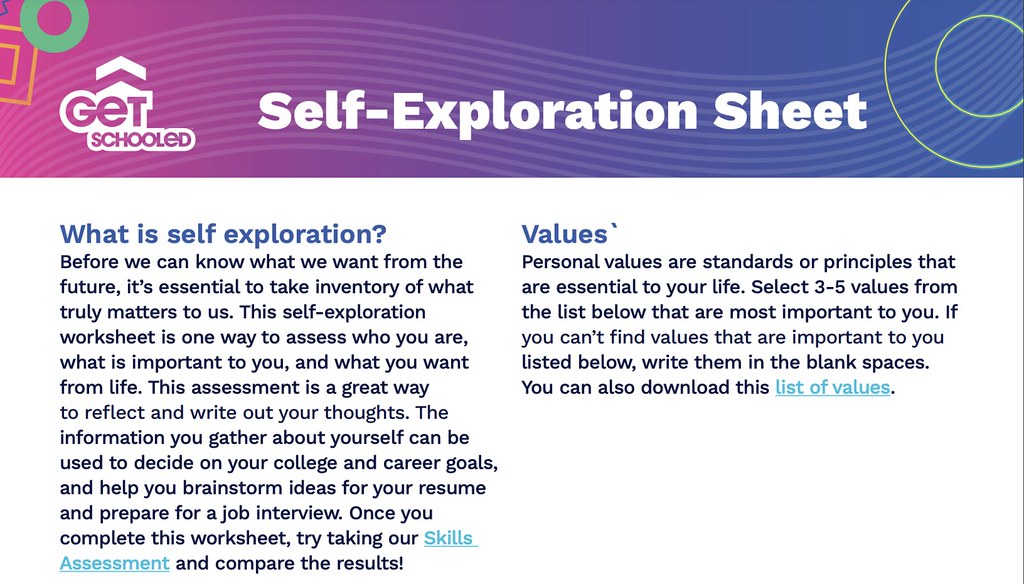
Before you can know what you want from the future, it’s essential to take inventory of what truly matters to you. This self-exploration worksheet is a way to assess who you are, what’s important to you, and what you want from life. This assessment is a great way to reflect and write out your thoughts.

Click the image below to download and fill out our self-exploration worksheet!

Screenshot of the Self-Exploration Worksheet- Self-Exploration Worksheet

Do you have any questions? Connect with a Get Schooled Advisor.

Keep going

Learn About Your Post-High School Options

Last updated June 8, 2026

In this article

The end of high school marks an important point in your life, and there are many educational and professional paths you can take from here! We know that deciding what comes after high school can feel intimidating, but with the right research, preparation, and support, you can make a choice that feels right for you. We share some post-high school options and resources to support along the way.

*Note: Before making a big decision about your post-high school plans, we strongly recommend talking to a parent, guardian, or trusted adult. They can support you in making a decision that’s best for you. 

(Lee este artículo en español aquí!)

Post-high school options

Attend college

Many students attend college after graduating high school. There are many great benefits of attending college, like learning and trying new things, discovering what you want to do professionally, making lifelong friends, and receiving a degree that may lead you to earn higher pay throughout your career. The two most common types of colleges are:

  • Two-year colleges (commonly known as community colleges). Students attending community college typically receive an associate degree in two years. From there, they can transfer to a four-year college or university to receive their bachelor’s degree or enter the workforce. Students typically apply to community college later in their senior year–usually sometime in the spring.
  • Four-year colleges and universities. Students typically receive a bachelor’s degree in four years before entering the workforce. However, even though these are commonly called “four-year colleges,” students can finish their degrees in shorter or longer time frames. Students typically apply to four-year colleges early in their senior year, in the fall. However, some schools may have rolling admission, meaning students can apply year-round as long as spots are still available

Decided that attending college is right for you? We have lots of resources to support you through every step of the college application process–from researching schools and beginning your applications to registering for classes and completing financial aid forms

Earn and learn

Become an apprentice

An apprenticeship is a career pathway that allows someone to gain on-the-job training, paid work experience, classroom instruction, and a nationally-recognized credential within their industry. Apprenticeship programs can open doors to hundreds of occupations, often in fast-growing industries. Some common occupations with apprenticeships include:

  • Electricians
  • Mechanics
  • Carpenters
  • Plumbers
  • Medical Assistants
  • IT Professionals
  • Teachers

….and many more!

Two young women look at a Mac computer and smile - Learn About Your Post-High School Options

Enroll in a trade school

Attending a trade school is a great way to learn hands-on skills and get hired into stable, in-demand careers! Trade programs are typically offered through community colleges and at technical and vocational schools. Students who study at trade schools typically receive a certificate of completion in their profession/area of study, but not an associate or bachelor’s degree. Trade school is a great option for students who know what they want to pursue professionally after high school. Finishing a trade program is often a great on-ramp to an apprenticeship, too!

Find a job

There are many reasons a student may choose to enter the workforce immediately after graduating high school, like supporting their family, taking time to weigh their educational options, and saving money. Whatever your reason, we are here to support you as you search for, apply to, and secure a great job! From creating a great resume and cover letter to preparing for interviews, we have resources to make your job search a success. 

The best choice you can make is the one that’s best for you. No matter the path you choose, we’re here to support you! Do you have any questions? Connect with a Get Schooled Advisor.

Keep going