Debit & Credit Cards: Pros & Cons

Last updated June 18, 2026

In this article

As a young adult learning about money management, you may be wondering about the differences between debit and credit cards. Both are common tools of building a strong financial future, so it’s important to know how each work. Debit cards use your own money right away, while credit cards let you borrow money and pay it back later. They both have their pros and cons. We break down what you need to know!
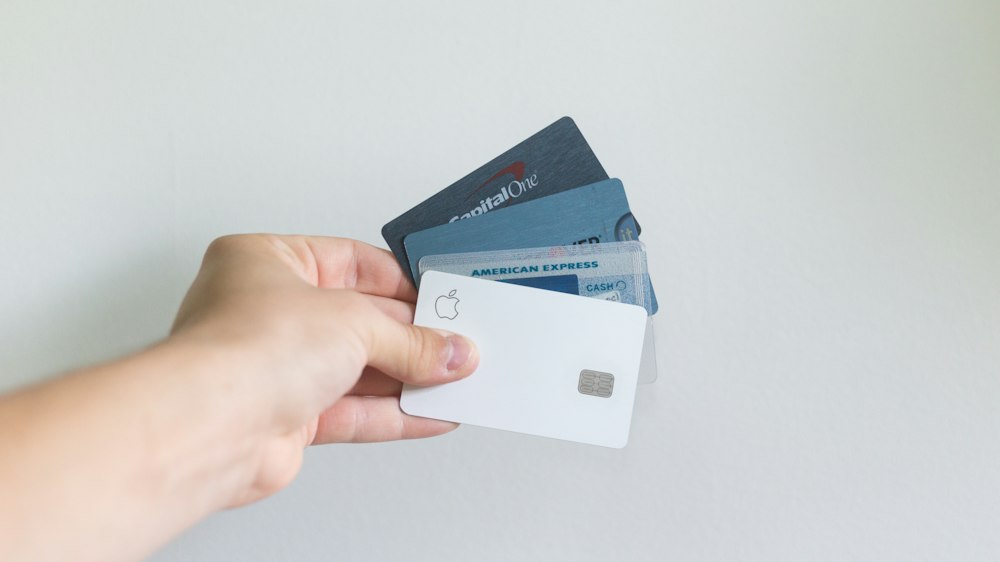
A hand holding up a variety of credit and debit cards - Debit & Credit Cards: Pros & Cons

What is a debit card? 

A debit card is a card linked to your checking account that allows you to make in-person and online purchases. When you buy anything with your debit card, the cost of the item is deducted from your checking account. Debit cards are commonly used in place of cash. Many first-time bank account users will opt for a debit card first, because they’re usually easier to manage and a bit more low-risk than credit cards. 

Debit cards: pros and cons

Pros

  • Linked directly to your checking account, which can prevent you from overspending, as you’re only able to spend the money you have available in your account.
  • Most require a pin number that only you know. If someone were to steal your card, they would have a more difficult time being able to use it and access your money. 
  • Some transactions can be monitored through your bank app, which may help protect your money if your card is lost or stolen.
  • Doesn’t require you to carry cash, which can be easily lost.

Cons

  • Transactions require action from your bank and from the seller of your purchase to clear it and update your account. This can be confusing, because until a purchase has cleared, you may still see the funds in your account, and end up accidentally overspending.
  • If you spend more money than you have available in your account (when making an online purchase, for example), you can accidentally overdraft. This means you’ve spent money you technically don’t have. When you overdraft, you can be punished by your bank with extra fees. 

What is a credit card?

A credit card is similar to a debit card in that it allows you to make in-person and online purchases. However, when you buy something with a credit card, the cost isn’t deducted directly from your checking account. Instead, it’s added to your credit card statement, which you must pay off proactively (usually around once a month) to avoid fees and interest. Credit cards must be applied for. Once you’re approved for a credit card, your credit card company will give you a certain spending limit each month. For example, if your credit card company gives you a spending limit of $2,000 each month, it’s your responsibility to make sure you don’t spend over that amount. You can link your checking account to your credit card to pay the card off each month. If you aren’t able to pay off your balance, it will have interest added to it for your next payment. 

Using a credit card wisely helps you build credit, a crucial component of your finances. A good credit score can allow you to borrow money with less interest. This is important if you want to lease an apartment with more ease or get a car loan in the future.

Credit cards: pros and cons

Pros

  • Allows you to borrow money up to your credit card limit. (Your credit card limit will vary based on your credit card company and credit history.)
  • Helps you build credit history, so that when you’re ready to make a large purchase, you have proof of accountability. Lenders typically offer lower interest rates and better terms to people with a strong credit history.
  • Often offers stronger fraud protection than debit cards, and some credit cards include rewards like cash back, points, or purchase protection when used responsibly.

Cons

  • Temptation to buy things that you may not have enough money in your checking account to purchase. This means that if you buy something with your credit card and are unable to pay off the balance within a month, interest will begin to accrue on your statement. 
  • Requires approval from a bank.
  • Can easily amass debt if you don’t pay the full balance on the card every month.
  • Not using it wisely can prevent you from renting an apartment or getting loans for larger purchases.
  • Depending on your bank, there may be a high interest rate to pay off purchases. 

For more money management tips, be sure to check out the rest of our money management resources to learn how to be a smart spender and saver! If you have any job or finance-related questions for us, connect with a Get Schooled Advisor!

Keep going

How to Build Credit as a Teenager

Last updated September 16, 2025

In this article

Because your credit score plays a big role in your long-term money management, it’s important to learn about how it works as a young adult. We know these concepts can be tricky to understand – which is why we’re here to help! We share tips on how to build credit as a teenager. 

Before making any big financial decisions, we strongly advise you to talk to a parent/guardian or a trusted adult. They can help you make informed choices about building credit and taking on debt that support your financial stability and success.

(Lee este artículo en español aquí!)

What is credit?

Credit, also known as a credit score, is a three-digit number on a scale of 300-850 that estimates how likely you are to repay borrowed money. Examples of borrowed money include money you’re authorized to spend on credit cards or loans you’ve been given by a bank. 

In the U.S., there are three major credit bureaus: Equifax, Transunion, and Experian. While they vary slightly by bureau, below are the general credit score ranges:

  • Excellent credit: 800-850
  • Very good credit: 740-799
  • Good credit: 670-739
  • Fair credit: 580-669
  • Poor credit: 300-579

Why is good credit important?

Good credit matters because it affects your eligibility to:

  • Secure loans. Whether you want to buy a car or house, strong credit history will make it easier to secure loans in the future. 
  • Secure lower interest rates. Strong credit history can help you secure lower interest rates on credit cards, car payments, and loans. 
  • Rent an apartment. With good credit, you may have a higher chance of securing an apartment. Landlords have the right to turn down your apartment application based on a lower credit score. 
  • Pay for utilities. A low credit score means you may have to pay a higher down payment or deposit for utilities like electricity.
  • Land a job. In some states, employers have the right to deny you employment based on your credit history.

What factors determine my credit score?

There are 5 components that determine your credit score:

  1. Payment history (35%) – Your payment history is a record of your on-time, late, and missed payments on loans and credit cards. It’s important to make payments on time, since late and missed payments may lower your score.
  2. Amounts owed (30%) – Also known as your debt-to-credit ratio, this number shows how much debt you owe and how much of your available credit on a credit card you’ve used. 
  3. Length of credit history (15%) – Your credit score is impacted by how long your credit accounts have been open: the age of your oldest account, the age of your newest account, and the average age of all your accounts combined.
  4. Types of credit in use (10%) – Having a variety of credit types (e.g. loans or credit cards) will help boost your credit score.
  5. Account inquiries (10%) – Whenever you apply for credit, lenders will review your credit score. Each time they do, credit bureaus keep track. Having too many account inquiries can lower your score.

Where can I find my credit score?

Only people with a credit history have credit scores. We recommend using annualcreditreport.com to review your credit history once a year for free. 

How to build credit as a teenager

Become an authorized spender

Becoming an authorized spender on a parent or guardian’s credit card allows you to make purchases while establishing your own credit. You will receive a credit card with your name on it, but the account holder (your parent or guardian) is ultimately responsible for making payments. 

Having a credit card is a big responsibility! If becoming an authorized spender is an option, it’s important to follow any instructions your parents or guardians give you about spending. For example, they may only allow you to use the card in case of emergency or give you a monthly spending limit. The choices you make as an authorized spender on their account can impact their credit score, so be mindful and responsible. 

Apply for a credit card

If you are prepared for the financial responsibility, you can apply for your own credit card. If you’re establishing credit for the first time, you may consider applying for a secured credit card. This type of card requires you to make an initial deposit (typically $200-$500) that becomes your line of credit.

For example, if you put down a $300 deposit, your credit card will have an available spending amount of $300. Your security deposit will be refunded once your account balance is paid off and the account is closed, or when your secured credit card is converted to an unsecured credit card.

This type of card is ideal for people just beginning to build their credit history and want to start small before applying for larger amounts of credit in the future. 

Make payments on time 

Late or missed payments on different types of expenses can negatively impact your credit score. Be sure to pay all of your bills–such as your credit card, rent, cell phone, car, or utilities–on time each month. Setting up a monthly auto payment can be helpful.

Keep your balance low and pay it off in full each month

A good general rule is to spend no more than 30% of your available credit on credit cards. For example, if you have a credit card with a total available amount of $500, you don’t want to have a balance of more than 30%, or $150.

Additionally, paying off your balance in full each month can have a positive impact on your credit score while helping you avoid interest charges. 

While building credit seems intimidating, it’s an essential part of financial stability! If you have any questions about how credit works, we recommend talking to a parent/guardian or a trusted adult in your life.

Do you have any questions about building credit as a teenager? Connect with a Get Schooled Advisor.

Keep going

What Teens Should Know About Good & Bad Debt

Last updated September 4, 2025

In this article

An important part of money management is understanding debt and how it works, since it can have significant impacts on your finances and credit in the future. There are different types of debt you will encounter as an adult – typically known as “good debt” and “bad debt” – but what’s the difference between the two, and how do they affect you? Here’s what teens should know about good and bad debt!

Note: Before making any big financial decisions, we strongly advise you to talk to a parent/guardian or a trusted adult. 

What is good debt?

“Good” debt is debt that helps you increase your wealth or income over time, often with lower interest rates than other types of debt. Examples of good debt include student loans. Student loans are considered good debt because you are investing in your education and working toward a credential or degree that can help you earn more across your lifetime, justifying the need to borrow money. That said, too much of any kind of debt can quickly turn into bad debt.

What is bad debt?

“Bad” debt typically refers to high-interest debt that’s difficult to repay and doesn’t contribute to your financial growth. While credit cards can be helpful in building and establishing credit, they are often considered a “bad” form of debt. This is because:

  • Many of them have high interest rates (around 20-22%).
  • Some companies might encourage you to pay only the minimum statement balance instead of paying in full every month, which will draw out the amount of time it takes for you to repay your debt with interest.
  • Some companies will offer rewards or incentives to encourage spending on your card. This can lead you to spend money that you might not have.

If you have a high-interest credit card and pay off your balance each month, then having a credit card shouldn’t be a problem. But if you have a high-interest credit card and are only paying the minimum balance every month, the debt will build up quickly, potentially making it harder and more expensive to pay it off. 

Do you have any questions about money management? Connect with a Get Schooled Advisor.

Keep going

Why Teens Should Open a Bank Account

Last updated September 24, 2025

In this article

Opening a bank account is a key step toward financial independence and security. While this process may sound confusing or intimidating, it’s totally worthwhile to set yourself up for the future! In this article, we’ll share six reasons why teens should open a bank account.

Note: Before making any big financial decisions, we strongly advise you to talk to a parent/guardian or a trusted adult. They can help you make informed choices about building credit and taking on debt that can ensure your financial stability and success in the future.

Financial independence

Having a bank account allows you to manage your money and make smart financial decisions, which are important steps toward becoming financially independent. Through a bank account, you can learn a lot about how you make and spend your money, which can give you the discipline down the road to manage bigger financial decisions such as securing loans for college or a car. By putting your money into a checking or savings account, you can start making your money work for you! 

Necessity and convenience

When you get a job, your bank account will allow you to receive your paychecks via direct deposit. If you use a payday lender or check-cashing business, they will take a percentage of your check just so you can receive your own money. Having direct deposit ensures that your entire paycheck goes to you! 

Additionally, through your bank account, you can easily deposit and withdraw money, make online purchases, and pay bills without having to rely on cash or money-sharing apps. Bank accounts, overall, make your day-to-day financial decisions much more convenient! 

Safety and security

Your bank account provides a secure place to store your money, since it’s insured by the FDIC (a federal agency). This means that if your bank were to go out of business, your money is still yours! This is more ideal than keeping stashes of cash that can be stolen or ruined, and more secure than keeping money in money-sharing apps, which have different levels of insurance than banks. 

When setting up a bank account, make sure that it is FDIC insured. This information should be easily available on a bank’s website. 

Budgeting and money management

Having a bank account makes it easier to keep track of your spending and budget your money. Most bank accounts offer online banking and a mobile app that can help you monitor your account activity and make sure you’re sticking to your budget. Many banks also offer financial education resources and programs that can help you learn more about managing your money and planning for the future. By signing up for a bank account, you can take advantage of these resources and gain valuable financial skills that will benefit you for years to come.

Saving money and preparing for the future

A bank account can help you save money! For example, there are features that allow you to automatically deposit a percentage of each paycheck into your savings account. All savings accounts, especially high-yield savings accounts, will also offer you interest, so as your money sits in the account, it will continue to grow! Having a solid history with banks, a positive relationship with your money, and a strong credit score will help you be financially independent in the long run.

Next steps

Now that you know the reasons to open a bank account, be sure to check out the rest of our money management resources to learn how to be a smart spender and saver! Have any job or finance-related questions for us? Connect with a Get Schooled Advisor.

Keep going

Why You Should Open a High-Yield Savings Account

Last updated September 4, 2025

In this article

As you start earning money from your first job or when you join the workforce after college, managing your finances wisely is crucial for building a secure future. A simple strategy to grow your earnings is by opening a high-yield savings account (HYSA). In this article, we’ll explain what high-yield savings accounts are, how they differ from a regular savings account, their benefits and drawbacks, and how they can support your financial goals! 

(Lee este artículo en español aquí!)

Understanding high-yield savings accounts

A high-yield savings account is a type of bank account that offers a significantly higher interest rate compared to traditional savings accounts. An interest rate is the percentage of your savings that the bank pays you in a year for keeping your money in the account. For example, if you have $1,000 in an account with a 4% interest rate, the bank will expect to add $40 to your savings after one year, depending on how often the interest compounds. It’s like a reward for saving your money! 

While a standard savings account might offer an interest rate or annual percentage yield (APY) of around 0.01%, HYSAs can provide APYs ranging from 4% to 5% or more, depending on the bank and the country’s economic conditions.

Comparing regular savings accounts and high-yield savings accounts

When deciding where to save your money, it’s helpful to know the difference between a regular savings account and an HYSA. Here are some important distinctions between the two: 

Interest rates (APY)

  • A regular savings account typically offers an APY of around 0.01% to 0.10%.
  • A high-yield savings account will likely offer significantly higher APYs–up to 5% or more.

Accessibility

  • Regular savings accounts are offered by traditional banks, where you can access in-person services at one of their branches.
  • High-yield savings accounts are usually offered by online banks, which may have limited or no in-person services for customers.

Fees

  • Regular savings accounts often have monthly maintenance fees or minimum balance requirements, which can reduce your savings.
  • Many HYSAs have no monthly fees or minimum balance requirements.

Purpose

  • Regular savings accounts might be more convenient for everyday banking needs or as a companion to a checking account.
  • HYSAs are ideal for longer-term saving goals because of their higher earning potential. 

Here is a scenario to show how your savings might grow in a regular savings account versus a high-yield savings account over time. Let’s say you start with an initial deposit of $1,000. You make monthly contributions of $50 for 5 years. Here is how your money will grow in each account:

With the HYSA, you basically earned $609 just for letting your money sit in that account! Check out this savings calculator to continue to illustrate this point. 

Choosing the right high-yield savings account

When choosing a high-yield savings account, consider the following factors:

Interest rates or APY

Look for accounts offering competitive interest rates. As of November 2024, some accounts offer APYs as high as 7% to 10% for teens, though these rates may only apply to lower balances. Regardless, you should look for rates of at least 4%.

Fees

Ensure the account has low or no monthly maintenance fees, as these can eat into your earnings.

Minimum balance requirements

Some accounts require a minimum balance to earn the advertised APY or to avoid fees. Choosing a lower minimum balance means you can start right now with less money up front.

Accessibility

Consider how easily you can deposit and withdraw funds. Online banks may offer mobile check deposits and ATM access, but be sure to verify these features before opening an account.

FDIC insurance

Confirm that the bank is FDIC insured to protect your deposits up to $250,000. This basically means that the government is saying that this bank is safe to put your money into! 

Building generational wealth starts with saving

Saving money isn’t just about preparing for emergencies or big purchases—it’s about building a foundation for generational wealth. By starting with an HYSA, you’re taking a crucial step toward managing your money wisely and setting the stage for long-term financial stability.

One of the biggest misconceptions about saving is that you need a lot of money to get started. That’s not true! Even saving $10 or $20 each month can make a difference. Here’s how:

Example: Starting small

  • Initial deposit: $50
  • Monthly contributions: $25
  • Savings period: 10 years
  • APY: 4.50%

With consistent contributions of just $25 per month, you can save nearly $4,000 in 10 years, with over $808 of that being interest earned!

This growth is the result of compound interest, where your savings earn interest, and that interest earns interest. Over time, this creates a snowball effect that turns small, consistent savings into a much larger amount. These kinds of savings can help you build an emergency fund, save for short-term goals like buying a car, avoid debt, and develop positive financial habits that you can use the rest of your life!

By starting small, thinking long-term, and choosing tools like HYSAs to grow your money, you can take control of your financial future and inspire those around you to do the same. Remember, the earlier you start saving, the more time your money has to grow, thanks to the power of compound interest.

Do you have any questions about opening a high-yield savings account? Connect with a Get Schooled Advisor.

Keep going

Checking & Savings Accounts: What’s the Difference?

Last updated September 4, 2025

In this article

There are two main types of bank accounts: checking and savings. We break down differences between the two and highlight why they’re important! 

Note: Before making any big financial decisions, we strongly advise you to talk to a parent/guardian or a trusted adult. They can help you make informed choices about building credit and taking on debt that can ensure your financial stability and success in the future. 

What is a checking account?

A checking account is a bank account for everyday expenses. You can use it to have paychecks deposited, make purchases, withdraw cash, and pay bills. It’s a convenient way to quickly access your money—anytime, anywhere. Requirements for opening a checking account will vary based on the bank you choose, but keep in mind there are fees associated with a checking account, like overdraw fees, if you don’t monitor it.

What is a savings account?

Money that you want to set aside for things like vacations, large purchases, or unplanned emergencies should go in a savings account. Unlike checking accounts, many savings accounts earn interest, meaning you earn a bit of additional free money each month just by keeping money in your account! This is especially true if you have a high-yield savings account, which earns more interest per month than regular savings accounts.  

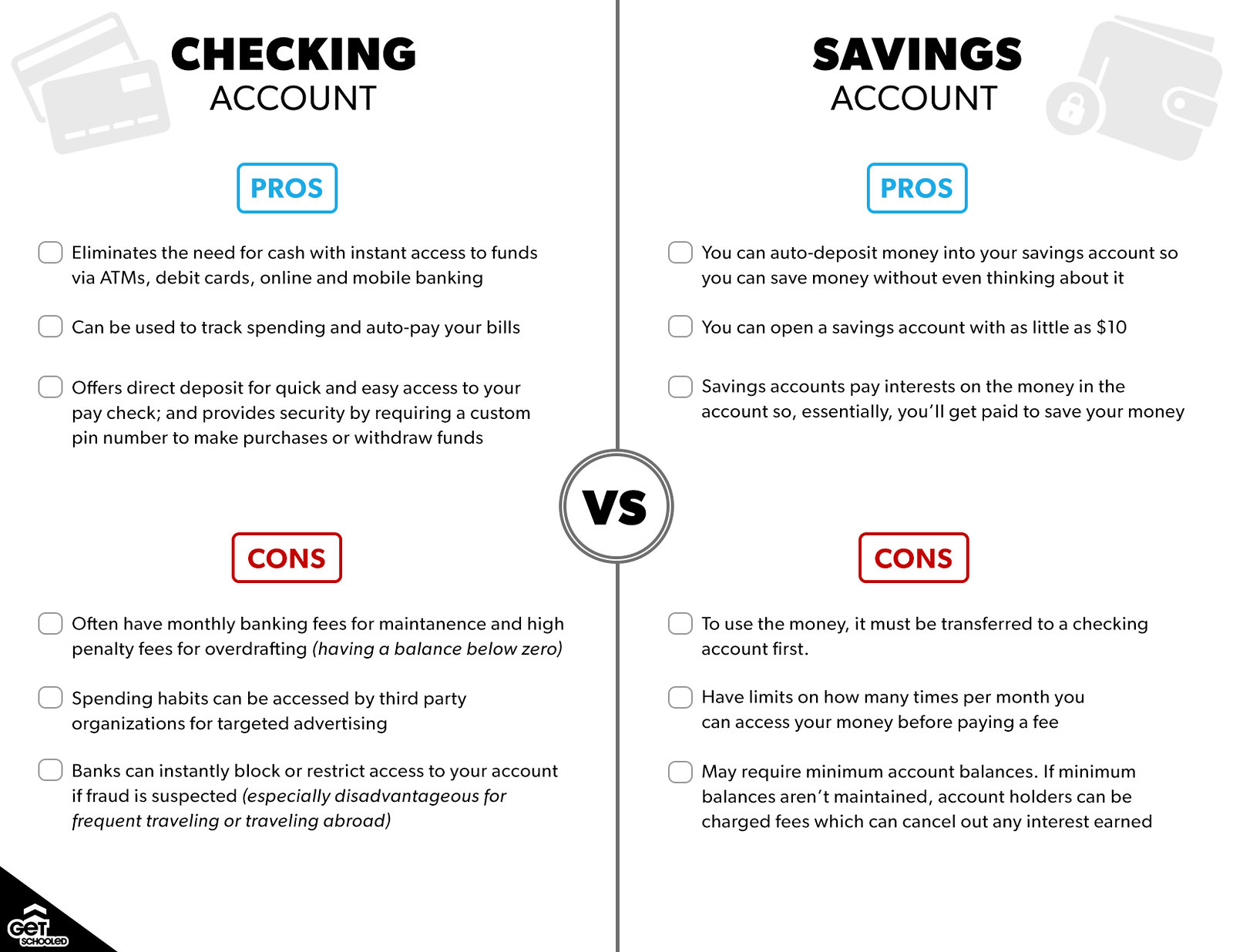
Take a screenshot or save the image below to reference when opening up a bank account!

Infographic identifying the differences between a checking and savings account, and the pros and cons for both -  Checking & Savings Accounts: What's the Difference?

For more money management tips, be sure to check out the rest of our free money management resources to learn how to be a smart spender and saver! And if you have any job or finance-related questions for us, connect with a Get Schooled Advisor.

Keep going

Understanding Credit Cards & Interest Rates

Last updated September 15, 2025

In this article

For many teens, credit cards and interest rates can seem like complex financial concepts. However, learning about them as a young adult is essential for building a strong credit history and good money management habits over time. In this article, we’ll help you understand credit cards and interest rates!

Note: Before making any big financial decisions, we strongly advise you to talk to a parent/guardian or a trusted adult. They can help you make informed choices about building credit and taking on debt that can ensure your financial stability and success in the future.

(Lee este artículo en español aquí!)

A young man with an afro holds a credit card and looks at his laptop computer - Understanding Credit Cards & Interest Rates

Key terms

Before we get into learning more about credit cards and interest rates, let’s define some key terms.

Credit card

A credit card is a payment card that allows you to borrow money to make purchases. When you use a credit card to make a purchase, you are essentially taking out a loan that you must pay back to a credit card company.

Credit score

A credit score is a three-digit number, typically on a scale of 300 to 850, that estimates how likely you are to repay borrowed money (credit cards, car payments, etc.) Credit scores are based on your credit history, including how much debt you have, how often you make payments on time, and how long you’ve had credit.

Interest rate

An interest rate is something that lenders charge you for borrowing money. Basically, it is an amount added to your borrowed amount, as a percentage. For example, if your credit card has an interest rate of 15%, and you have a balance of $1,000, you would be charged $150 in interest (on top of paying off the initial $1,000).

APR

APR stands for “annual percentage rate.” This is the interest rate that you are charged on your credit card balance. The APR includes both the interest rate and any fees that may be associated with the card. This is a very important term to look for when applying for a credit card.

Variable interest rate

A variable interest rate is an interest rate that can change over time. This means that the interest rate on your credit card could go up or down depending on market conditions. Often, the APR or variable interest rate on a credit card application will be listed as a range of percentages. For example, you might see “APR: 13.9%–20.9%”. This means that while you have this credit card, your interest rate may be as low as 13.9%, but could increase to 20.9%.

Account balance

Your account balance is the amount of money you owe on your credit card. This includes any purchases you have made, as well as any fees or interest charges that have been added to your balance.

How do credit cards work?

When you use a credit card to make a purchase, you are essentially taking out a loan from the credit card company. You will need to pay back the money you borrowed, along with interest and any fees that may apply. Credit cards typically have a grace period, which is the amount of time you have to pay off your balance before interest starts to accrue. The grace period will vary depending on the credit card company and the terms of your agreement.

If you do not pay off your balance by the end of the grace period, you will be charged interest on the remaining balance. The interest rate can vary depending on several factors, including your credit score, the credit card company, and the terms of your agreement.

Why get a credit card?

There are many reasons to get a credit card and start building credit as a teen or young adult:

  • Build credit history. Using a credit card responsibly can help you start building a credit history, which can be important when applying for loans, renting apartments, or even getting a job in the future.
  • Emergency funds. Having a credit card can provide a safety net in case of emergencies, such as unexpected car repairs or medical bills.
  • Convenience. Credit cards can make it easier to make purchases online or in person without needing to carry cash.
  • Rewards and benefits. Some credit cards offer rewards programs, such as cash back, points, or airline miles, which can be a great way to save money on everyday purchases. Other cards may offer additional benefits, such as purchase protection or travel insurance.

Why do interest rates matter?

Interest rates are an important factor to consider when using credit cards. It is always good to keep in mind that this is how credit card companies make their money, so always be sure to know the terms of any interest rates you’re signing up for. The higher the interest rate, the more you will have to pay back over time.

Interest rates can be fixed or variable. A fixed interest rate remains the same over time, while a variable interest rate can change based on market conditions or other factors. Many credit cards will offer you an initial interest rate of “0% APR.” However, it’s important to understand that 0% interest rates almost always expire after a specific time frame. For example, a credit card may be zero interest for only the first six or twelve months. 

You’ll often see this written as “0% intro APR for six months on purchases and then a variable APR of 12.99% – 21.99%.” This doesn’t mean that you won’t have to pay interest on your first six months’ worth of purchases. It means that you have that grace period of six months to pay your balance off without interest. After that, any balance left over will be subject to that higher APR.

Tips for using credit cards wisely

Follow these tips to use your credit card wisely and avoid debt:

  • Only use your credit card for purchases that you can afford to pay off in full each month. This will help you avoid interest charges and keep your balance low.
  • Set a budget for your credit card spending and stick to it. This will help you avoid overspending and keep your expenses under control.
  • Pay your credit card bill on time each month to avoid late fees and negative marks on your credit history.
  • Monitor your credit card statements regularly to ensure that all charges are accurate and to identify any fraudulent activity.
  • Look out for fees. Many credit cards come with fees, such as annual fees, late payment fees, or over-limit fees. These fees can add up quickly and make it harder to pay off your balance.
  • Be aware of theft and fraud. Credit cards can be a target for fraud and identity theft. It’s important to monitor your credit card statements regularly and report any suspicious activity to your credit card company immediately.

Do you have any questions about building credit as a teen or young adult? Connect with a Get Schooled Advisor.

Keep going

How to Open a Bank Account as a Teen

Last updated December 10, 2025

In this article

Having a bank account is important for your financial independence, the safety of your hard-earned money, and building a financially secure future. Choosing a bank and opening an account can seem a bit intimidating, but by following these steps, you can do it with ease! We show you how to open a bank account as a teen.

*Note: Before making any big financial decisions, we strongly advise you to talk to a parent/guardian or a trusted adult. They can help you make informed choices that support your financial stability and success in the future.

(Lee este artículo en español aquí!)

Scattered bills and coins - How to Open a Bank Account as a Teen

Types of banks

There are three main types of banks you may want to choose from when opening your first bank account:

  • Commercial banks. These are the most common types of bank, and they offer a wide range of services such as checking and savings accounts, loans, and credit cards. Examples of commercial banks include Bank of America and Wells Fargo.
  • Credit unions. These are nonprofit organizations that are owned and controlled by their members. They offer many of the same services as commercial banks, but they usually have lower fees and better rates. Examples of credit unions include Navy Federal Credit Union and State Employees Credit Union.
  • Online banks. Many of these banks don’t have physical branches, but they offer many of the same services as commercial banks. They may offer higher interest rates on savings accounts and lower fees. Examples of online banks include Ally Bank and Capital One.

Features, benefits, and relationship to the community

Choosing a bank and the types of accounts you want to open is a big decision, so research is key! The Consumer Financial Protection Bureau, a federal agency, has a helpful activity for you to consider while you do your research. You’ll want to think about what kinds of features are most important to you before opening an account at any bank. Do you want a checking or savings account, ATMs close to your house, or a great online app? Are there fees associated with opening an account or a minimum balance you need to keep? These are all key questions to consider in your research.

You should also consider what kind of relationship any bank has with your community. Do you know other people who bank there? What has their experience been? You can also research different banks and credit unions in your area to find one that has a history of serving and supporting your community.  

Prepare to apply

Once you’ve decided where you want to bank, you’ll need to apply for an account, which will require some paperwork. The kinds and amounts of paperwork can vary depending on the bank, so be sure to check in about what’s needed with a bank employee to get the correct information. You will most likely need:

  • A form of ID (driver’s license, passport, or state ID card).
  • Your Social Security number (SSN) or taxpayer identification number (TIN).
  • Proof of address, such as a utility bill or lease agreement.
  • A school ID if you are under 18 years old.
  • An initial deposit to open the account.
  • A parent or guardian’s signature and ID if you are under 18 years old.
  • A document that shows your address if you are under 18 years old.
  • Proof of income if the account requires a minimum balance.

If you are under 18, there are ways that you might be able to get a bank account without a parental signature. For example, if you are 16 or 17 years old, have proof of identification, and can show a source of income, some banks may offer you something called a “noncustodial” account. This means that you won’t need a parent or guardian’s signature to open and control the account. Be sure to ask your bank if they offer this option if it’s something you’re interested in.

Get banked!

Once you’re approved, you’ll need to deposit some money into the account to open it. Be sure you make yourself familiar with all the features of the account once you set it up: research how to make deposits, how to withdraw money when needed, and how to check your account balance. It’s also important to learn about the fees associated with your account and how to avoid them. Talking with a banking professional can go a long way! Take a moment to explore the bank’s mobile app, which can make managing your money on the go much easier. It’s also helpful to set up account alerts so you’ll be notified of low balances, deposits, or unusual activity.

Have any questions about finding and choosing a bank? Connect with a Get Schooled Advisor and check out all of our free resources on money management

Keep going