No matter what’s distracting you, test out a few of our tips to help you eliminate distractions and focus on studying!
Can’t focus at home?
Try changing your scenery and studying at a library or coffee shop. If you prefer to study with company, invite your friends or classmates to join you!
Use headphones
Distracted by noise at home or at your favorite study spot? Put in headphones and listen to some white noise to zone in on your studying.
Turn off your phone
Phones can be one of the biggest distractions when studying! The best way to avoid constantly looking at your phone is to turn it off (or put it in airplane mode or do not disturb) for an hour or two at a time to focus on getting your studying done.
Try the Pomodoro technique
The Pomodoro technique can help you focus on a task by using timed sessions and a timed break in between each one. Here’s how it works:
Choose a task to work on.
Set a timer for 25 minutes.
Work on the task until the timer ends. On a piece of paper, give yourself a checkmark.
Take a 5-minute break.
After 4 Pomodoro sessions (checkmarks), take a longer break (15-30 minutes).
Whether your phone, social media, or the noise of your family is distracting you while studying at home, it’s important to stay focused. Here are a few of our best tips to focus on studying at home!
Set up a study space
Dedicate an area at home where you can study without interruptions. Let everyone in your home know that when you are in this dedicated area, they shouldn’t disturb you. Having an area you can associate with studying and school work will help you focus.
Use headphones
Try listening to music or white noise to turn a busy place into a zen space! Headphones can help block out noise and signal to others that you are busy. Create a study playlist with your favorite songs, add white noise tracks, or classical pieces. No headphones? Play music or white noise in the background from a computer, radio, or TV.
Turn off your phone or place it 5 feet away from you
The best way to avoid the temptation of checking your notifications is to turn your phone off when studying. If you need to leave it on, place the phone 5 feet away from you. Having to walk to your phone will add another layer of effort before you can check it. This extra action may be enough to deter the habit of checking your phone when you should be studying!
Study with friends
Set up a video call to study with friends. For this to work, you all have to agree to block out a set time of studying before socializing. By uniting around a common goal, you can get your respective assignments and studying done together.
Try the Pomodoro technique
The Pomodoro technique can help you focus on a task by using timed sessions and a timed break in between each one. Here’s how it works:
Choose a task to work on.
Set a timer for 25 minutes.
Work on the task until the timer ends. On a piece of paper, give yourself a checkmark.
Take a short 5 minute break.
After 4 Pomodoro sessions (checkmarks), take a longer break (15-30 minutes).
Keeping track of your academic, personal, and professional responsibilities requires time management skills, and the best time to build them is now. We’ll show you how to plan for a productive day!
Use a planning tool
Using planning tools like journals or apps can help you keep track of your daily, weekly, or monthly schedule. Write down all of your obligations in a given time frame, like school, work, extracurriculars, or plans with friends to understand what you have going on. Whatever medium helps you keep track of everything is great, as long as you will be consistent with using it!
Review your schedule the night before
At the end of each day, review the day you’ve had by checking off what you accomplished. Ask yourself, what is in progress and what do you need to start? This will help you prioritize tasks the next day with everything fresh on your mind.
Establish a morning routine
What do you need to do in the morning to have a good day? It could be having breakfast, doing your hair, making your bed, or listening to music. Whatever it is, try to do this every morning to get yourself in the mindset to tackle your responsibilities of the day. Building smaller habits like this can make it easier over time to build bigger and more consistent habits!
Block out time for breaks and eating
In the midst of everything you have going on, block out time on your schedule to move, stretch, eat, and rest. Taking care of yourself and getting good rest can lead to better productivity in other areas of your life!
Identify and limit distractions
If you find yourself being distracted by things like your phone or social media, set some firm boundaries for yourself. Doing things like reducing your social media usage to only 5 minutes per hour or putting your phone on do not disturb can help you better focus and take care of your responsibilities.
Preparing for a big exam? While test-taking can be a source of anxiety for some students, you will be on track to succeed with some time and preparation. In this article, we share tips to help you prepare for a big exam!
Determine what you know and what you don’t know
Efficiency is key when preparing for an exam. Try to prioritize studying topics or concepts you don’t feel as confident in. After you’ve spent a good portion of your time covering these areas and feel confident enough to move on, spend some time reviewing the material you already know.
Figure out what your study style is
Are you the type of learner that likes making flash cards? Or do you like studying in a group? Think about what is the best way for you to study and stick to that! Some students like studying alone so they don’t get distracted, while some students like studying with a partner so they can ask each other questions. Figuring out what your study style is can be a huge help for you as you plan for the big exam.
Make a study guide
Creating a study guide to organize class material can help you prepare for an exam. Don’t be afraid to try a new way to study. Some students like to rewrite or reorganize their notes, others like to make flashcards, and some write out paragraphs and highlight key terms in different colors. Learn more about effective ways to format your study guide!
Talk to your teacher or professor
Some teachers and/or professors will host office hours or time after school where you can ask for help. Don’t be afraid to ask your teacher/professor for help directly. If they offer office hours or a time when you can meet with them, plan to do that. They can clarify confusing topics, suggest what to focus on, or even share practice problems to guide your studying. Reaching out early also shows initiative, which can make class discussions and future assignments feel much more manageable.
Create a study schedule and find a good place to focus
Start studying at least 2-3 weeks ahead of a big exam. Try to dedicate 30 minutes to one hour, at least three times per week, to studying. You may also want to create an ideal study space, so whether you prefer to study in a cafe or at home, make sure you take the necessary steps that allow you to study distraction-free.
Studying for a big exam can be intimidating, but with the right preparation, you will be on your way to success! Do you have any questions about preparing for an exam? Connect with a Get Schooled Advisor.
No matter the class or subject, having good study skills is essential to succeeding academically. There’s no “right” way to study, but there are some helpful habits and tips that you can incorporate into study methods that already work for you. Here are some of our tips and strategies to study effectively!
Before class
Read all of your assigned readings before going to class. When you finish your readings, try explaining the concepts and ideas in your own words by writing down notes or talking about them with a classmate. Note any questions about concepts you don’t fully understand, and ask your professor or teacher during class or office hours if you’re in college!
In class
While you’re in class, be sure to take notes. If your professor or teacher prepares slides ahead of time, download them so you can take notes as they review them and go over new material. If they do provide slides, you don’t need to copy the text on them word for word. Instead, pay close attention to the additional context being presented on the topic. If you don’t understand something, be sure to ask questions.
After class
Once you’ve gotten through class, make a study guide or review your notes. Condense your notes into your own words to make sure you grasp important concepts. Make sure you note any new knowledge you are still unclear of so that you can follow up with your teacher or professor.
Review
Spend some time reviewing your notes and study guide. This will help make sure that you are grasping the course materials and retaining information. Cramming might work in a pinch, but won’t help you learn in the long run. This is especially important if it’s information from the beginning of the term that you’ll need to remember for the final.
Prep for exams
Schedule test dates on your calendar. Take a few minutes to decide what, when, and how you will study each day leading up to the exam. This will help you make sure you have enough time to prepare and cover all relevant materials before the exam. Try your best to stick to your plan, but leave room to make adjustments if needed.
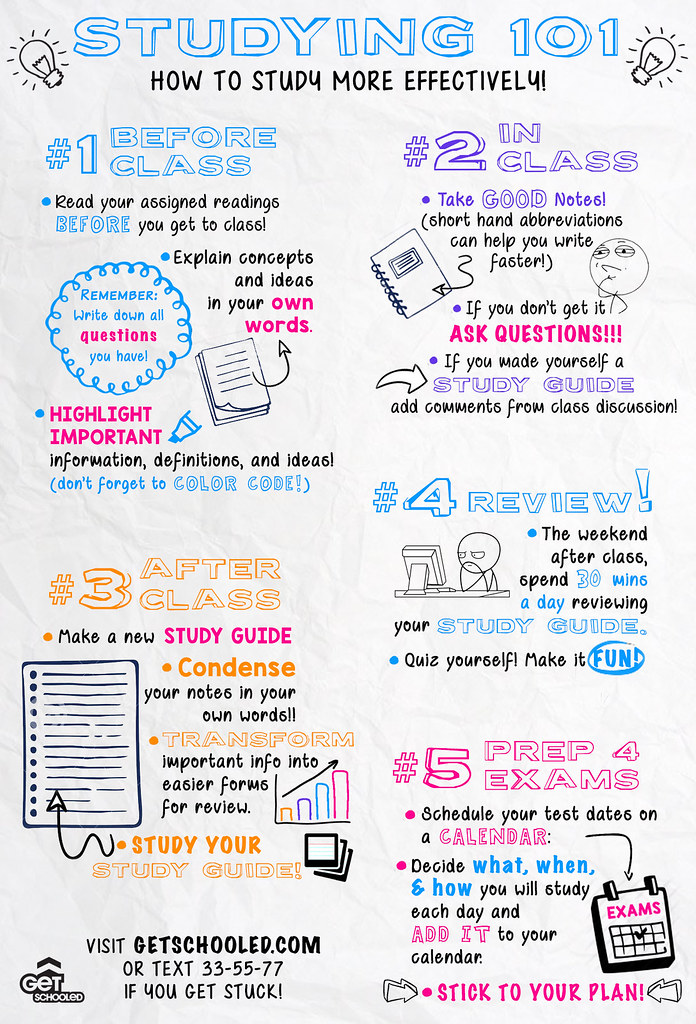
Screenshot or save the image below to have handy when you need some study inspiration!
Whether you’re preparing for a big exam or want to reinforce your learning, creating a clear study guide can be helpful. Depending on the class and subject, you’ll want to tailor the contents and design of your study guide to optimize your study time. The goal is to make a study guide that organizes the information you need to know in a format that caters to your learning style! If you’re unsure of how to format your study guide, consider some of the following formats based on the type of learner you are!
If you’re a visual learner, you can color-code your study guide or transform certain information into graphs, charts, or illustrations to help you retain information.
If you’re more of a linear learner, we recommend organizing the information on your study guide into lists. This can mean lists in chronological order, alphabetical order, or whichever order best supports your learning style.
Gamifying or switching up the format of your studying can be beneficial and fun! You can record yourself reciting definitions or key themes and listen to it throughout the day. You can also create flash cards or turn your notes into a matching or memory game.
If you’re a dot connector or learn best through storytelling, try transforming concepts from subjects like math and English into a story that you can connect with. Then, organize your study guide like a short story that you can recite to remember how to apply those concepts.
Click the button below to download our free guide on formatting your study guide!
Have you ever been in the middle of taking a test, staring blankly at the paper below you, and felt like you forgot everything you studied? Or maybe you’ve found yourself feeling nauseous, distracted, or hopeless. These feelings could be a symptom of test anxiety.
Test anxiety manifests differently from person to person. Put simply, however, test anxiety is feelings of extreme panic, anxiety, or stress before, during, or after an exam. While it’s normal to feel some level of nervousness during an exam, test anxiety can negatively impact your confidence and academic performance. To help you cope with test anxiety, read our list of strategies below.
Revamp your study habits
Showing up to an exam feeling well prepared can help reduce test anxiety. More importantly, the earlier you prepare can help ease your anxiety in the days leading up to the test. Check out some of our best study and productivity tips to make the most out of your studying:
Cramming for an exam is not effective, so we don’t recommend doing it. Staying up late the night before an exam to study will likely only make you feel groggy the next morning, which can distract you from fully focusing. Make sure you give your brain an opportunity to rest and recharge.
Eat and drink water beforehand
Have you ever felt annoyed or irritated for no reason, only to realize it’s because you haven’t eaten all day? Imagine feeling that way while trying to take a test. Having adequate food and water in your system can help you focus more during your exam.
Incorporate mindfulness and relaxation techniques
We encourage you to practice mindfulness exercises like deep breathing, meditation, or progressive muscle relaxation to calm your nerves before and during exams. Apps like Calm and Headspace, and any free resources that could be available at your school/college that offer guided relaxation exercises can be particularly helpful.
Manage your time effectively
Planning out strategies ahead of time can make a difference! You can strategize by pacing yourself during tests, or skimming the entire test first, tackling easier questions first to build confidence, and setting aside time for review. Thinking of testing strategies can help you feel more in control and reduce anxiety mid-exam.
Optimize your focus with white noise or Hertz music
Listening to white noise or Hertz music while studying can help improve focus and productivity by creating a calm and consistent environment. Unlike songs with lyrics, which can be distracting as your brain processes the words, instrumental tracks or sounds like white noise, rain, or specific frequencies (e.g., 432 Hz or 528 Hz) promote relaxation and enhance concentration. Try looking on Youtube for playlists designed specifically for studying to find the soundscape that works best for you.
Discuss the power of positive self-talk
Do you know how to replace negative thoughts with positive affirmations? Practicing positive selt talk can look like “I’ve studied and am prepared for this test” or “I can handle this.” Positive self-talk can significantly boost confidence and reduce stress during high-pressure situations.
Still need help coping with test anxiety?
Practice good self care. Whether you’re in high school or college, read about our self-care tips and activities to try out before your next exam.
Seek professional help. Test anxiety can sometimes be a symptom of something bigger, like anxiety, depression, or imposter phenomenon. Talking to a professional about how you feel can give you some insight into why you feel that way, how to spot patterns in your mood, and help you prioritize your mental health.
Whether you’re taking the SAT or ACT or are studying for a final exam, you will encounter tests in high school and college that have multiple choice questions. In this article, we’ll share tips on how to answer multiple choice questions with confidence!
Read the entire question
Read a multiple choice question all the way through before looking at the answer options. While this may seem like common sense, it’s helpful to remember when you’re under a time crunch or are sure you know the answer despite not having read the entire question.
Answer it in your mind first
After reading a question, answer it in your mind before reviewing the answer options. This will help prevent you from talking yourself out of the correct answer.
Use the process of elimination
Cross out all the answers you know are incorrect, then focus on the remaining answers. Not only does this strategy save time, it increases your likelihood of selecting the correct answer.
Use the true or false test
If you’re unsure of the answer options for a question, give each one a true or false test. Cross out the false answers first before identifying the correct answer.
Look for answers hidden in questions
Sometimes, answers are hidden right in the question! This is another reason it’s important to read the question thoroughly before answering it.
Answer the questions you know first
If you get stuck on a question, move on to the next one. Answer all the questions you’re confident about first before going back to the ones you’re unsure of. This can save you time and some pressure!
Know when to avoid selecting “All of the above” or “None of the above”
When you encounter an “All of the above” answer choice, do not select it if you are pretty sure that one or more of the other answer choices provided is incorrect. The same applies for “None of the above” if you are confident that at least one of the answer choices is correct.
Keep an eye on the clock
While it’s important to do your best to answer questions correctly, it’s just as important to make sure you answer all of them within your allotted time. Before your next multiple choice exam, practice your time management skills to make sure you’re ready to go.
AP courses can be challenging. With the right preparation, you’ll be set up for success! Here’s how to feel confident and succeed in your AP courses and exams.