If you plan to attend college or a trade school next school year but haven’t completed the FAFSA yet, keep reading! While there may be various reasons that you haven’t yet completed the FAFSA, we want to tell you that there’s still time.
The deadline to complete the 2025-2026 FAFSA isn’t until June 30, 2026, but there are many advantages to completing it ASAP. When you complete the FAFSA early, especially before your state’s or colleges’ deadlines, you can be considered for the maximum amount of aid possible.
Even if you’re not sure about how much aid you’re eligible for due to factors like your family’s financial situation, it’s still worth the time to complete your FAFSA. Don’t count yourself out until you’ve explored your options!
With this in mind, we’ll share some reasons to complete the FAFSA now if you haven’t yet.
You have more options
It’s important to know that completing the FAFSA doesn’t commit you to anything–it simply gives you more options to choose from. You are not required to attend any of the colleges you listed on your application. You are also not required to accept all –or any – of the aid you’re offered from colleges in your financial aid offer letters. You can select the aid you want and reject the rest. Here are three ways the FAFSA gives you options:
You have more college options. By completing the FAFSA, you increase your chances of receiving federal, state, and institutional aid that can make attending a certain college more affordable and within reach.
You have more financial aid options. A large majority of federal, institutional, and state aid (including scholarships, loans, and grants) is awarded to students only if they’ve completed the FAFSA. This means more aid options are potentially available to you.
You have more potential job options. When completing the FAFSA, you can be considered for work-study, a federal aid program that allows eligible students to work part-time, on-campus jobs to earn money to help pay for school expenses.
You don’t need to navigate this process on your own! There are plenty of free resources available that can support you through completing and submitting your FAFSA. Here’s a few:
Our textline. After signing up for our free FAFSA textline, you can speak with one of our college advisors to have your questions answered!
Our FAFSA resources. We have lots of resources (both in English and Spanish) to help you and your family understand the purpose of the FAFSA, how to complete and submit it, and how to choose a college based on the aid offers you receive.
FAFSA help in every state. Each state has free FAFSA help through in-person and digital FAFSA workshops, online FAFSA resources and modules, and FAFSA support specialists you can reach over the phone or text.
Receiving the financial support you need can make transitioning to college easier and smoother, so we strongly encourage you to make a plan to complete the FAFSA as soon as possible!
For many college students, working at least part-time is necessary to afford school and living expenses. The federal work-study program provides jobs to eligible college students with financial need to help pay for those expenses! Here’s everything you need to know about work-study.
Work-study is a federal student aid program that provides eligible students at participating colleges with part-time jobs.
How do I qualify?
Eligibility for work-study is determined once you’ve completed or renewed the FAFSA. On your FAFSA, you will be asked if you’re interested in being considered for work-study. If you are, be sure to check “Yes.” If your college participates in the work-study program, and you meet their eligibility requirements, you’ll see “Work-Study” listed on your financial aid offer letter.
Note: Because work-study eligibility is determined by completing the FAFSA, undocumented students unfortunately do not qualify.
How does payment work through work-study?
If you are eligible for work-study, you will be paid hourly and will earn at least the current federal minimum wage. The hours you work cannot exceed the total amount of your work-study award for the year.
What kinds of work-study jobs are there?
Work-study jobs typically vary by college. The opportunities offered can be both on and off-campus depending on your school and how many jobs are available. Here are some common work-study jobs:
Library assistant
Working in a library might involve data entry, helping students find books and resources, supporting librarians, and checking resources in and out of the library. Since you’ll already be in the library, your work environment will likely be quiet and calming, and may even offer you time to read or do homework for your classes when it’s slow. This job will likely help hone your organizational and data management skills.
Research assistant
This kind of job is especially great if you’ve already chosen a major or want to explore a specific subject or area of study in more depth. You will most likely be paired with a graduate student and/or professor working on a specific course of study. You most likely will help with research, writing, and data entry. You may discover that you really love this subject and decide to explore it further!
Peer tutor
Are you highly confident in a specific subject area? Do you have a great system for studying and staying on top of all your work? Chances are there is a tutoring position available to you! If you’re interested in education, helping other students learn, and want to become great at explaining hard concepts, definitely keep the tutoring center in mind.
Fitness center assistant
A campus fitness center is a high-traffic place that could use work-study employees to support with reception, cleaning, and maintenance. If you like the atmosphere of a gym, this position may be for you!
How do I choose the best work-study job for me?
It’s up to you to decide what kind of jobs you want to apply for! Some work-study jobs are great because they provide flexible hours and convenient on-campus locations, while others will provide more career-oriented experiences. Here are some tips for landing the best job for you:
Start early
Head to your school’s career center to learn about available work-study positions. Narrow down the list of jobs you’re interested in to decide which ones you want to apply for. After that, make sure you have your job application materials (like your resume and cover letter) ready to begin applying!
Know your schedule
Be sure to keep things like your class and extracurricular schedules in mind when considering or committing to a work-study job. Knowing when you will and won’t be able to work in a week can help you narrow down your decision.
Consider the type of work experience you want
What are you interested in learning? What skills do you want to build? Being able to answer these questions and share your insights with someone in the career center can help you find the right work-study job for you.
When reviewing your college financial aid offer letter, you may see that you automatically received the Pell Grant without having applied for it. But what is the Pell Grant and how does it work? We break it down!
The Pell Grant is a form of federal financial aid that is awarded to students with significant financial need. Unlike loans, Pell Grant funds do not need to be repaid. Once an eligible student has completed or renewed their FAFSA, these funds are automatically awarded and are reflected in their college’s financial aid offer letter.
How much money will I receive through the Pell Grant?
Many factors, such as your Student Aid Index (SAI), financial need, student status (full- or part-time), and the cost of attendance at your college determine the amount you may receive through the Pell Grant. Because each of these factors can change each academic year, the amount you may receive in Pell Grant funds may vary. For the 2025-2026 academic year, the maximum amount of the Federal Pell Grant is $7,395. Although this is the maximum amount, some students are eligible to receive up to 150% of their scheduled grant through the “Year-Round Pell” program. If you qualify for more funds, your school can help you determine how much and how it will be distributed according to the grant schedule.
Am I eligible for the Pell Grant?
Eligibility for the Pell Grant is determined by completing or renewing the FAFSA, as well as your financial need, family size, or household income. To estimate how much you might receive in Pell Grant funds if you are an eligible student, you can use FSA’s Pell and SAI Eligibility Guide for 2026-2027.
How do I apply for the Pell Grant?
You do not need to specifically apply for the Pell Grant! As mentioned above, eligibility for the grant is determined by completing or renewing the FAFSA. If you meet all the eligibility criteria, you will automatically receive the funds and see the exact amount offered in your financial aid offer letter.
Benji, Arizona’s virtual FAFSA assistant, can answer questions to help you complete and submit the FAFSA—both in English and Spanish. Text “Hi Benji” to (602) 786-8171 or use the chat bot on the website to begin.
Students can also sign up for one-on-one FAFSA assistance over Zoom (both in English and Spanish) from the Arizona FAFSA Coalition.
You can also check out College Ready AZ’s calendar of free in-person and virtual FAFSA events happening across the state.
Additionally, students can call the Arizona FAFSA Hotline, which is open Monday-Friday, 9 am-3pm. Call 1-833-AZFAFSA for assistance in English, and 1-833-MIFAFSA for assistance in Spanish.
Arkansas
ASLA College Planning Services has free resources and tips to support students as they save for and apply to college, as well as apply for federal and state financial aid and scholarships. Call (800) 443-6030 or email Plan4College@asla.info if you have questions.
California
Cash for College California offers free virtual and in-person workshops across the state to help students and families complete their FAFSA, California Dream Act (CADAA), or Chafee Grant for Foster Youth applications. Workshops are held from October 1-June 30, annually.
Colorado
Colorado’s Department of Higher Education offers free digital resources to help students and families complete the FAFSA and learn about scholarships and other forms of financial aid.
Connecticut
FAFSA Connecticut has information (both in English and Spanish) to help students learn more about the FAFSA, CSS Profile, and scholarships.
Georgia Student Finance Commission offers in-person trainings, workshops, and information sessions across the state to help students and their families plan for college. Use their calendar to find a FAFSA completion or financial aid event near you. Additionally, they also offer free virtual FAFSA resources for students and parents.
Hawaii
College is Within Reach Hawaii will offer free FAFSA completion webinars to get step-by-step FAFSA assistance. These webinars will take place on Wednesdays from 6-7:30 pm until March 11, 2026.
Next Steps Idaho has free digital resources that help students understand both how to complete the FAFSA and what happens after they submit it.
Illinois
Illinois Student Assistance Commission offers free financial aid presentations and StudentAid.gov account (FSA ID) creation workshops in English and Spanish across the state. Just enter your zip code to find an event near you! Additionally, you can get one-on-one assistance with college planning and financial aid from an ISACorps member in your area.
Use Kentucky Higher Education Assistance Authority’s (KHEAA) free FAFSA Completion Guide as you work on the FAFSA. Be sure to also check out KHEAA’s YouTube channel, which posts informational videos about completing the FAFSA.
Louisiana
Register a free FAFSA session with a Louisiana Office of Student Financial Assistance (LOSFA) representative by scrolling down and clicking the yellow button that says “Register for a FAFSA or Financial Literacy Session.” If you are not at least 18 years old, you will need to submit a parental consent form.
MI Student Aid offers virtual FAFSA and financial aid application presentations to students and families. Register in advance.
Minnesota
Minnesota Goes to College offers Zoom sessions to help students and families create their StudentAid.gov accounts, complete the FAFSA, apply to college, and apply for scholarships.
If you can’t attend an upcoming session, they provide presentation recordings and slides for free FAFSA help.
Mississippi
Book an appointment through Get2College to ask questions you have about planning and paying for college. Virtual appointments can be made through one of Get2College’s in-person locations or by calling (662) 349-2789 or (228) 875-4441.
The Montana University system has free resources to support students completing their FAFSA and weighing their college financial aid options. Additionally, Reach Higher Montana has lots of information to help students apply for the FAFSA and other forms of financial aid.
Nebraska
With EducationQuest Foundation, students can make virtual one-hour FAFSA help, general financial aid help, and college planning appointments. Services are also available in Spanish.
Nevada
Apply Nevada has a list of FAFSA-related FAQs to help students understand how to complete the form.
College for North Carolina offers video resources to help students and families understand and complete the FAFSA. They also have an interactive map that helps you find a financial aid professional that can support FAFSA completion near you.
Oregon Goes to College offers lots of financial aid information and resources for students, including what they need to know about completing the FAFSA.
Mapping Your Future has free resources on a variety of topics surrounding financial aid—creating your StudentAid.gov account, completing the FAFSA, finding scholarships, and more. They also offer free virtual financial aid event nights at select high schools across the state. Additionally, Dakota Dreams has FAFSA completion resources available to students.
Tennessee
College for TN offers free FAFSA events, videos, and webinars. You can reach out to an Outreach Specialist in your area (scroll down to THEC Outreach Team) if you have any questions or call 1-800-342-1663.
College Access Fairfax offers free workshops to high school seniors to learn more about paying for college and completing the FAFSA. Additionally, they have a library of resources on topics like scholarships, understanding your financial aid award letters, and more.
Washington
Students can talk with OtterBot, a free, 24/7 texting service that helps students in Washington navigate financial aid for college. Text “Hi Otter” to (360) 928-7281 to begin. Parents can also reach out to OtterBot by sending “Hi OtterBot” to (360) 634-0354.
The 2026-2027 Free Application for Federal Student Aid (FAFSA) is open! It’s important to note that while states or colleges may have their own FAFSA deadlines, you can technically still submit your FAFSA after they’ve passed, as long as you submit it before the federal deadline (June 30, annually). State and institutional FAFSA deadlines typically check a student’s eligibility for state and institution-specific grants and scholarships, but are not mandatory if a student prefers to submit their FAFSA by the federal deadline. In any case, we highly encourage you to meet your state and institutional deadlines to ensure you’re being considered for the maximum amount of aid possible!
With this in mind, here are FAFSA deadlines by state.
Complete the FAFSA by March 2, 2026 to be considered for state-based aid. Cal Grant requires submission of a school-certified GPA by March 2, 2026. To qualify for additional community college Cal Grants, submit by September 2, 2026.
Colorado
No state deadline; check in with the school(s) you applied to about their deadline.
Connecticut
For priority consideration, submit by February 15, 2026. Check in with the school(s) you applied to about their deadline.
Delaware
May 15, 2026. Check in with the school(s) you applied to about their deadline.
District of Columbia
Priority deadline: June 25, 2026. To be considered for the DC Tuition Assistance Grant, submit by July 1, 2026.
Florida
May 15, 2026. Check in with the school(s) you applied to about their deadline.
Georgia
Apply as soon as possible after FAFSA opens. Check in with the school(s) you applied to about their deadline.
Hawaii
Check in with the school(s) you applied to about their deadline.
Idaho
Complete the FAFSA by March 1, 2026 to be considered for state-specific aid, such as the Idaho Opportunity Scholarship.
Illinois
Complete the FAFSA as soon as possible to be considered for state-specific aid, such as the Monetary Award Program (MAP).
May 1, 2026. Check in with the school(s) you applied to about their deadline.
Michigan
For priority consideration, submit by July 1, 2026. Check in with the school(s) you applied to about their deadline.
Minnesota
To be considered for the State Grant and North Star Promise, submit your application by the 30th day of the term. Check in with the school(s) you applied to about their deadline.
Mississippi
Complete the FAFSA by April 30, 2026 to be considered for state-specific aid, such as the HELP Grant. To be considered for the MTAG and MESG grants, submit by October 15, 2026.
Missouri
Priority deadline: February 2, 2026. Regular deadline: April 1, 2026. Check in with the school(s) you applied to about their deadline.
Montana
For priority consideration, submit as soon as possible. Check in with the school(s) you applied to about their deadline.
Nebraska
No state deadline; check in with the school(s) you applied to about their deadline.
No state deadline; check in with the school(s) you applied to about their deadline.
New Jersey
Renewal applicants for the Tuition Aid Grant (TAG) should submit by April 15, 2026. First-time applicants should submit by September 15, 2026.
New Mexico
No state deadline; check in with the school(s) you applied to about their deadline.
New York
June 30, 2027. Check in with the school(s) you applied to about their deadline.
North Carolina
Submit your FAFSA for priority consideration at a UNC System Institution by June 1, 2026. For priority consideration at a community college, by August 15, 2026.
North Dakota
ASAP after FAFSA opens; check in with the school(s) you applied to about their deadline.
Ohio
October 1, 2026; check in with the school(s) you applied to about their deadline.
Oklahoma
No state deadline; check in with the school(s) you applied to about their deadline.
May 1, 2026. The deadline for all first-time applicants planning to enroll in a community college, business/trade/technical school, hospital school of nursing, designated Pennsylvania open-admission institution, or nontransferable two-year program is August 1, 2026.
Rhode Island
No state deadline; check in with the school(s) you applied to about their deadline.
No state deadline; check in with the school(s) you applied to about their deadline.
Tennessee
March 2, 2026 for State Grant prior-year recipients and for consideration for the Tennessee Promise. For the State Lottery, submit by September 1, 2026.
Texas
Priority deadline: January 15, 2026. Check in with the school(s) you applied to about their deadline.
Utah
To be eligible for the Opportunity Scholarship, Apply ASAP. Check in with the school(s) you applied to about their deadline.
Vermont
ASAP after FAFSA opens; check in with the school(s) you applied to about their deadline.
Virginia
ASAP after FAFSA opens; check in with the school(s) you applied to about their deadline.
Washington
ASAP after FAFSA opens; check in with the school(s) you applied to about their deadline.
West Virginia
ASAP after FAFSA opens; To be eligible for the PROMISE Scholarship, submit by March 1, 2026. To be eligible for state-based grants, submit by April 15, 2026.
Wisconsin
No state deadline; check in with the school(s) you applied to about their deadline.
Wyoming
No state deadline; check in with the school(s) you applied to about their deadline.
It’s not too late to complete the FAFSA! There’s still time to submit your FAFSA and increase your chances of receiving financial aid for college and career.
Before completing the FAFSA, you’ll first need to create a StudentAid.gov account (also known as an FSA ID). It’s used to confirm your identity when accessing federal financial aid information and to sign your FAFSA electronically when you submit it. You are required to create a StudentAid.gov account to access, sign, and complete the FAFSA. Dependent students (students who live with their parent(s)/stepparent(s) and rely on them for financial support) will have contributors to their FAFSA. Contributors will need to create their own StudentAid.gov accounts to complete their portion of the FAFSA.
In this article, we’ll show you how to create a StudentAid.gov account!
What information will I need to create my StudentAid.gov account?
Username and email address. Create a username that is unique and that you can easily remember. The email address you provide should be different from your contributors’ email addresses. Phone numbers cannot be used as login credentials.
Address and phone number. Parents and students can list the same phone number for multi-factor authentication across multiple accounts (up to five).
Social Security number. Contributors without an SSN can still create an account.
Challenge questions. If you ever forget your login information and don’t have access to your mobile number or email, you will be asked a question to confirm your identity. During setup, you get to choose a question and answer it. Later, if you need to gain access to your account, your challenge question will be shown to you, and the answer you provide must match the answer you submitted when you created your account. Be sure to write down the questions and answers you select.
Creating a StudentAid.gov account and completing the FAFSA as an undocumented contributor
Parent(s) without an SSN can still make an account and contribute to a student’s FAFSA. Just have them select the “I don’t have a Social Security number.” box on the account creation page.
It’s important to understand that at this time, personal data submitted through the FAFSA—including a contributor’s citizenship status—may or MAY NOT be protected by the U.S. Department of Education. While contributing to a student’s FAFSA as an undocumented parent generally should not affect their eligibility to receive federal financial aid, other potential risks that undocumented contributors may face are currently unknown. Before completing the FAFSA, we advise you to talk to your family to make an informed decision that works best for you.
2. Click “Create Account” at the top right of the home page
You will need to create your own account separate from your contributors. After you create yours, they will need to create theirs.
When you go to create an account, you’ll be asked to verify your email address. FSA’s system will check to see if you already have an account or if you need to make a new one.
3. Enter your personal information
Provide your name and Social Security number exactly as they appear on your Social Security card.
4. Make sure all your information is correct and press submit
If there’s an error with any of your personal information, it will cause issues after you submit your FAFSA, so be sure to verify that it’s all correct.
What’s next after creating my StudentAid.gov account?
Once you and your contributors have created your accounts, your accounts will be authenticated and you can start completing the FAFSA!
The 2026-2027 Free Application for Federal Student Aid (FAFSA) is open! If you need money for college, completing the FAFSA is the most important and reliable way to increase your chances of receiving it. We share a step-by-step guide on how to complete the FAFSA!
Before you get started, you and your contributors will need to create StudentAid.gov accounts (formerly known as FSA IDs) to access the application. A contributor is anyone who is required to provide information on the FAFSA. Contributors are:
Student (that’s you)
Parent(s)/Step parent(s)
Spouse (if legally married)
Accounts are authenticated instantly and students and families can begin the application immediately.
To create your StudentAid.gov account, you will need your Social Security number, a reliable phone number, and your email address. You will not be able to complete the FAFSA without a StudentAid.gov account. Make sure you double check for correct spelling and any unnecessary characters if you are having trouble creating an account. Names on Social Security cards should match the information listed on the FAFSA.
Creating a StudentAid.gov account will require you and your contributors to set up at least one form of Multi-Factor Authentication (MFA), which is another layer of security to keep your information safe. You can set this up using a phone number, email, authentication app, or a one-time backup code (keep safe).
Creating StudentAid.gov accounts for contributors
If you’re a dependent student (you live with your parents and rely on them for financial support such as food and housing), one or both of your parents will need to create their own StudentAid.gov accounts. Keep in mind that your parent(s) will need their own email address to create a StudentAid.gov account. After your and your contributors’ StudentAid.gov accounts are created, you can begin filling out your FAFSA.
How do I know if I am dependent/independent for FAFSA purposes?
Most students will file the FAFSA as a dependent student, even if they have filed their taxes or support themselves. FAFSA only considers a student independent for the following reasons:
24 years old during award year
Married (or separated, not divorced)
Working on advanced degree
Serving in armed forces or veteran
Since age 13: not living with parents, in foster care, or ward of court
Emancipated minor
Have a court-ordered legal guardian
Have children or dependents and provide more than half of their support
Unaccompanied youth who is homeless
What do l need to fill out the FAFSA?
Here’s what you need to complete your FAFSA if you’re a dependent student:
Alien Registration Number (A-Number) for eligible noncitizens (if applicable).
2024 Federal tax information, tax documents, or tax returns including IRS W-2 information for you and your parents.
Records of your untaxed income, such as child support received for you and for your parents if you are a dependent student.
Information on cash; savings and checking account balances; investments, including stocks and bonds and real estate (but not including the home in which you live).
Net worth of family businesses with more than 100+ employees. Do not report the value of family farm or fishery business.
A list of colleges you intend to apply to (if you’re completing the FAFSA for the first time). You do not have to be accepted to any of these colleges at the time you complete your FAFSA. You can list up to 20 colleges.
For most families and students, completing the FAFSA takes around one hour.
How do I get started?
To begin filling out your FAFSA, visit the Federal Student Aid website. Click “Start New Form.” You will be asked for your login credentials (StudentAid.gov account) and can follow the instructions on the form.
After students and their contributors (parents) create their StudentAid.gov accounts, they can begin the application. Each student and contributor will need their own separate StudentAid.gov accounts.
Step 1: Gather all relevant information and documents needed to complete the form.
Step 2: Start the form by selecting the application for the 2026-2027 academic year.
Step 3: Begin the application. Do not forget to provide consent for IRS data to be transferred. If you do not consent, you will not be eligible for aid.
Step 4: Complete all the required sections, including personal information, demographics, personal circumstances, finances, and list of colleges.
Step 5: If you are a dependent student (most students will be) you’ll need to invite one of your contributors to complete their part of the FAFSA. Start by entering the email of one contributor, and they’ll be invited to fill out their section. If a second contributor is required, you or the first contributor can invite the other parent or spouse.
*Provisionally independent students do not need to invite contributors and will complete after their section.
Step 6: Sign and submit your portion of the application and follow up with your contributors to ensure they log on and complete their portion.
Step 7: Contributors access their portion of the FAFSA by using their StudentAid.gov account. If your parents are married and filed taxes jointly, only one parent will need to do this part. If your parents are married and did not file taxes jointly, they will both need to complete it. Check out this article for other scenarios!
Step 8: Once your final contributor completes their portion of the FAFSA, they can sign and submit the application. You will receive a confirmation email letting you know that your application has been successfully submitted.
Step 9: You can track the status of your application by logging onto your StudentAid.gov portal and visiting the “My Activity” tab.
When can I start filling out my FAFSA?
The 2026-2027 FAFSA is open.We recommend completing it as soon as possible to maximize the aid you are eligible for. Don’t wait!
Make sure to double-check the dates before you start filling out the form. You want the FAFSA labeled with the school year for which you need aid (not the current academic year). Pay close attention to school and state FAFSA deadlines.
What’s the deadline to complete my FAFSA?
FAFSA deadlines vary by state and college.Learn your deadlineand be sure to apply well before it. The federal FAFSA deadline is June 30th, annually.
My parent(s) are undocumented, but I am a citizen/permanent resident. Can I still fill out the FAFSA and receive financial aid?
If you’re a dependent student living with one or more undocumented parents, you can still complete the FAFSA with your Social Security number. Parent(s) without an SSN can still make a StudentAid.gov account and contribute to a student’s FAFSA.
It’s important to understand that at this time, personal data submitted through the FAFSA—including a contributor’s citizenship status—may or MAY NOT be protected by the U.S. Department of Education. While contributing to a student’s FAFSA as an undocumented parent generally should not affect their eligibility to receive federal financial aid, other potential risks that undocumented contributors may face are currently unknown. Before completing the FAFSA, we advise you to talk to your family to make an informed decision that works best for you.
I am undocumented. Can I complete the FAFSA?
Unfortunately, the FAFSA is only available to those with permanent residence or citizenship in the U.S. If you are not in a position to complete the FAFSA due to your immigration or citizenship status, many states may have their own financial aid application that you can complete instead. Check with your school counselor to see what options there are in your state.
No! You should never pay to fill out the FAFSA. Be sure you are on studentaid.gov at all times throughout the FAFSA completion process and be wary of filling out any forms or documents that don’t look official. We recommend completing the FAFSA alongside a parent or trusted adult to ensure the process goes smoothly and safely.
Check out our list of FAFSA help by state, which breaks down the free virtual and in-person resources available to students completing the FAFSA in your state.
It’s not too late to complete the FAFSA! There’s still time to submit your FAFSA and increase your chances of receiving financial aid for college and career.
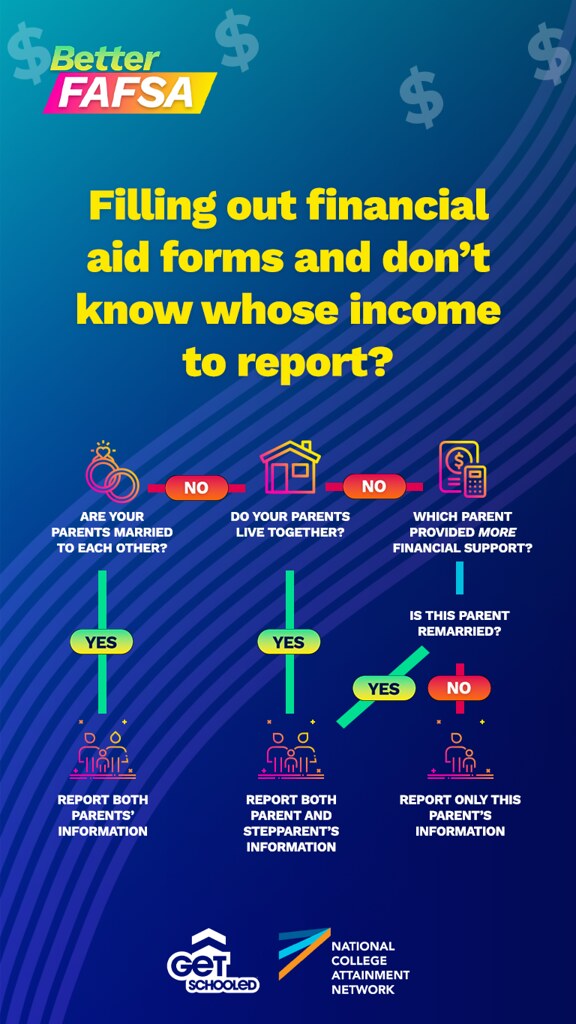
Unsure of whose income you should report on your FAFSA as a college student? We break it down here!
Click the image below to download!
Whose income do I report on my FAFSA?
There are a few key questions that help you determine which parent’s income(s) you will have to report on your FAFSA:
Are your parents married to each other?
If your parents are not married, do they live together?
If your parents are not married and do not live together, which parent provided more financial support?
This can obviously get confusing! Be sure to talk with your parent(s) and stepparent(s) as you go through this process! Federal Student Aid also has a tool for you to determine who to list.
Contributing to a student’s FAFSA as an undocumented parent/guardian
If you’re a dependent student living with one or more undocumented parents, you can still complete the FAFSA with your Social Security number. Parent(s) without an SSN can still make a StudentAid.gov account and contribute to a student’s FAFSA. Just have them select the “I do not have a Social Security number” box on the account creation page.
It’s important to understand that at this time, personal data submitted through the FAFSA–including a contributor’s citizenship status–may or MAY NOT be protected by the U.S. Department of Education. While contributing to a student’s FAFSA as an undocumented parent generally should not affect their eligibility to receive federal financial aid, other potential risks that undocumented contributors may face are currently unknown. Before completing the FAFSA, we advise you to talk to your family to make an informed decision that works best for you.
Having trouble accessing parent information?
If you are unable to provide parent information due to no contact, you can select “Yes” to the “Do unusual circumstances prevent the student from contacting their parents or would contacting their parents pose a risk to the student?” question on the FAFSA. You will have to follow up with the financial aid office of your college to provide supporting documentation.
Completing the Free Application for Federal Student Aid (FAFSA) is one of the most important things you can do to increase your chances of receiving many forms of financial aid for college! We break down the information you’ll need to complete the FAFSA in college.
Before starting your FAFSA
You and your contributors must create StudentAid.gov accounts to be able to complete the FAFSA. A contributor is anyone who is required to provide information on your FAFSA, such as:
Students (that’s you!)
Parent(s)/Stepparent(s)
Spouses (if applicable)
Accounts are authenticated instantly and students and families can begin the application immediately.
What information do I need to complete the FAFSA?
Here is everything you will need to complete the 2026-2027 FAFSA:
Your Social Security number.
Your contributors’ Social Security numbers.
Alien Registration Number (A-Number) for eligible noncitizens.
2024 federal tax information, tax documents, or tax returns, including IRS W-2 forms or information for you and your contributors (this will be pulled electronically from the IRS, but is good to have on hand).
Records of your untaxed income, such as child support received for you and for your contributors if you are a dependent student.
Checking and savings account balances.
Net worth of investments, including stocks, bonds, and real estate (but not including the home in which you live).
Net worth of family businesses with more than 100+ employees. Do not report the value of family farm or fishery business.
A list of colleges (up to 20) you intend to apply to (if you’re completing the FAFSA for the first time). You do not need to be accepted to any of these colleges at the time of completing your FAFSA.
Contributing to a student’s FAFSA as an undocumented parent/guardian
If you’re a dependent student living with one or more undocumented parents, you can still complete the FAFSA with your Social Security number. Parent(s) without an SSN can still make a StudentAid.gov account and contribute to a student’s FAFSA. Just have them select the “I do not have a Social Security number” box on the account creation page.
It’s important to understand that at this time, personal data submitted through the FAFSA—including a contributor’s citizenship status—may or MAY NOT be protected by the U.S. Department of Education. While contributing to a student’s FAFSA as an undocumented parent generally should not affect their eligibility to receive federal financial aid, other potential risks that undocumented contributors may face are currently unknown. Before completing the FAFSA, we advise you to talk to your family to make an informed decision that works best for you.
Complete the FAFSA!
To complete your portions of the FAFSA, you and your contributor(s) can head to studentaid.gov, log in using your StudentAid.gov accounts, and begin!
If you’re new to completing the FAFSA, here are 10 facts you need to know about it!
Completing the FAFSA may make you eligible to receive different types of financial aid
Completing the FAFSA doesn’t commit you to anything—it simply gives you more options to choose from. You are not required to attend any of the colleges you list on your application. You are also not required to accept all (or any) of the aid you’re offered from colleges in your financial aid offer letters. You can select the aid you want and reject the rest. Here are three ways the FAFSA gives you options:
You have more college options. By completing the FAFSA, you increase your chances of receiving federal, state, and institutional aid that can make attending a certain college more affordable and within reach.
You have more financial aid options. A large majority of federal, institutional, and state aid (including scholarships, loans, and grants) is awarded to students only if they’ve completed the FAFSA. This means more aid options are potentially available to you.
You have more potential job options. When completing the FAFSA, you can be considered for work-study, a federal aid program that allows eligible students to work part-time, on-campus jobs to earn money to help pay for school expenses.
You and your contributors must set up a StudentAid.gov account (FSA ID) before completing the FAFSA
You and your contributors (parents or spouses) are required to create StudentAid.gov accounts to access, complete, and submit the FAFSA. You will not be able to access the FAFSA without it. Accounts are authenticated immediately and you can proceed with the form.
You will use financial information from two years ago
For the 2026-2027 FAFSA, you will use a completed 2024 income tax filing.
The 2026-2027 FAFSA is open and will close on June 30, 2027
While the federal deadline for the FAFSA is June 30, some states and colleges have their own deadlines. Be sure you know both your state and college’s FAFSA deadlines to ensure you’re submitting on time.
You will probably need to provide parent information on the FAFSA
If you’re a dependent student living with one or more undocumented parents, you can still complete the FAFSA with your Social Security number. Parent(s) without an SSN can still make a StudentAid.gov account and contribute to a student’s FAFSA.
It’s important to understand that at this time, personal data submitted through the FAFSA—including a contributor’s citizenship status—may or MAY NOT be protected by the U.S. Department of Education. While contributing to a student’s FAFSA as an undocumented parent generally should not affect their eligibility to receive federal financial aid, other potential risks that undocumented contributors may face are currently unknown. Before completing the FAFSA, we advise you to talk to your family to make an informed decision that works best for you.
You must use accurate financial information when completing your FAFSA
The FAFSA allows contributors’ tax information to be pulled directly from the IRS, allowing for the most accurate reporting. Contributors must consent for IRS data information to be pulled to qualify for aid. Submitting inaccurate financial information may cause your FAFSA to be selected for verification or rejected.
Some states require you to list colleges in a certain order on the FAFSA
Colleges will use multiple methods to follow up on your FAFSA
To make sure you’re receiving crucial information relating to your FAFSA submission, check your physical mailbox and email regularly. Be sure to tell your contributors to do the same, since they will need their own email for any official correspondence from FSA.
Most states offer free FAFSA help
Check out our list of FAFSA help by state to learn what free resources and supports are available to you.
If you have questions or need help with your FAFSA, support is out there!
In addition to the resources we shared above, there are other ways to receive help on your FAFSA! If you have any questions or need support, connect with a Get Schooled Advisor.