Your college tuition bill outlines the specific costs of your upcoming academic term. If you need some help understanding your tuition bill, we’re here to help! Check out our sample bill below to learn more.
Components Of A College Tuition Bill
Note: Your bill may look different depending on your college. If you have any questions, reach out to someone in your school’s financial aid office for help.
Due date
This is the date you must pay your tuition by. It’s crucial to pay your balance or set up a payment plan by this date to ensure you are able to start taking classes.
Charges or new activity
This section shows the total amount you owe before any financial aid is applied.
Tuition
This is the cost of the classes you’re taking.
Fees
You may have additional fees not included in the cost of your tuition, such as facility fees for campus maintenance, technology fees for things like WiFi, and specific course-related fees such as lab fees for science classes. These fees will be itemized on your bill.
Health insurance
Most colleges require students to have health insurance while enrolled. While many colleges typically allow students to submit proof of outside health insurance, you may need to pay for insurance through your school.
Room and board
The costs of your dorm room, meal plan, and other on-campus housing services will be listed here. Costs may vary depending on the type of room and meal plan, so be sure to explore all your options.
Financial aid
All the forms of financial aid you’ve accepted, such as grants, scholarships, or loans, will appear in this section. If anything is missing, be sure to contact your school’s financial aid office.
Payments
This section shows any payments already made, including your enrollment deposit. These will appear as negative balances and will be subtracted from your total charges.
Balance due
After subtracting your financial aid and any payments from your total charges, your bill will list a final balance due. This can be paid in full by the due date or through a payment plan set up through your school’s financial aid office.
Click the image below to download our guide on understanding your college bill!
If your family’s financial circumstances changed since the tax year you reported on your FAFSA, you may be eligible to complete a change in financial circumstances appeal form once you receive your financial aid offer letter from your college. But what does a change in financial circumstances mean, and how does this form work? We break it down!
What is a change in financial circumstances appeal form?
Many college financial aid offices offer a change in financial circumstances appeal form, which allows you to formally request that they take a deeper look at your family’s current financial situation by submitting supporting documentation. Depending on your school, the form may go by different names, such as “Special Condition/Income Adjustment Form”, “Change to Your Award Request”, or “Change of Circumstances Appeal.” Many schools have the form or outline the process on their financial aid website.
What do I do if I know my financial situation has changed while I wait for my offer letter?
If you know that your family’s financial situation has changed drastically since 2024 (the tax year the 2026-27 FAFSA uses), look at your school’s financial aid website to learn more about their appeals process. Each school will have its own process, but you may be able to submit something along with documentation while you wait to receive your financial aid offer letters.
What is a change in financial circumstances?
A change in your family’s financial circumstances can include (but is not limited to) job loss, income reduction, change in marital or dependency status, and unexpected medical expenses. If you provide documentation to your school’s financial aid office that shows your family’s financial situation underwent notable changes during the past two years, your financial aid offer could be adjusted to reflect your circumstances, potentially increasing your aid.
How to complete a change in financial circumstances appeal form
While a change in financial circumstances appeal form can differ depending on your college, here is what the process typically looks like:
Contact your college’s financial aid office to request a change in financial circumstances form and/or set up an appointment with them.
Provide documentation that shows that your family’s financial situation underwent notable changes in the past two years. Some examples of documentation include:
Signed and dated copy of their most recent tax return, including W2(s) and/or 1099(s).
Letter of separation from an employer.
Copy of an unemployment benefits statement.
Recent pay stubs.
Proof of change in marital status.
Complete the form as instructed by your college. In the instance where your dependency status changes, you may be required to update your FAFSA.
You may also be required to submit an appeal letter detailing your change in financial circumstances. We recommend using SwiftStudent—a program that helps you write a financial aid appeal letter for free—to help.
What if I don’t have the required documentation?
There are some cases in which a student may be unable to provide the financial information of a parent or guardian. Colleges may be able to grant a dependency override, which is usually a longer process and will require submitting more supporting documentation. If you are unable to provide your parent or guardian’s financial documents, get in touch with your financial aid office to explain your situation. They can support you through the process of appealing for a dependency override, which means that you may be considered an “independent” student rather than a “dependent” one.
Dependency overrides are typically available for students with complex familial situations, such as:
Those who have estranged relationships with their parents or guardians.
What to expect after submitting the form
Depending on the school, the review process for a change in financial circumstances can take weeks or months. If approved, your financial aid offer will be adjusted to reflect your current financial circumstances. If your change in financial circumstances appeal form is denied, talk to a financial aid advisor to see if any adjustments can be made to your existing offer. You can also find other forms of financial aid, such as scholarships or loans, to cover any unmet financial need.
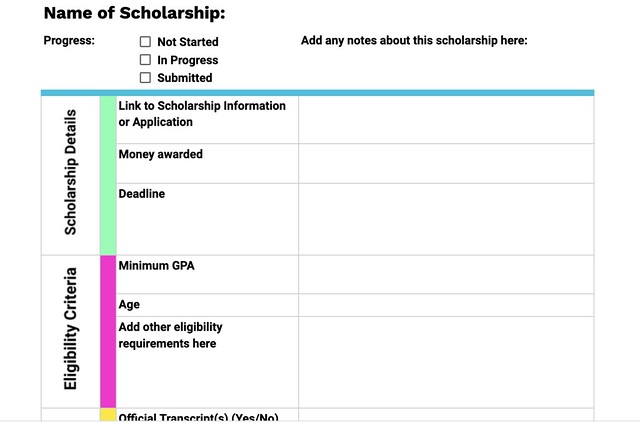
Starting your scholarship search? Use our free scholarship requirements tracker to stay organized! It’s an easy way to keep track of deadlines, required materials, and submission details all in one place. Download it now to stay focused and stress-free while applying for scholarships!
To make a copy of the Google Sheets version, click the image below!
To make a copy of the Google Docs version, click the image below!
Start your scholarship search using our Scholarship Finder!
There are millions (yes, millions) of dollars in scholarships available out there for students right now! The key is knowing where to find high-quality ones that match your interests and goals. In this article, we’ll show you how to find scholarships for college!
Think about your interests, background, and goals
Because there are so many scholarships out there, it’s likely that many you find will align with your interests and goals. Taking a moment to reflect on these things before starting your search can help you narrow down which you will and won’t apply for. What do you want to study in college? What causes do you believe in? What are your academic and career goals? No matter your answers, there’s a scholarship out there for you!
Use trustworthy websites and databases
While there are many trustworthy scholarship websites and databases out there, others unfortunately may sell student data, bombard users with advertisements, or attempt to scam students. To make your search easier and safer, we made a list of the best scholarship websites for finding money, a list of legit websites categorized into those that don’t sell data, those that do, and those that might if you don’t specifically request that they don’t.
A general rule is that legit scholarships will:
Never ask you to pay to apply. If you’re ever asked to pay, leave the website.
Usually never ask you extremely personal or sensitive information, such as citizenship or DACA status, sexual orientation, etc. If you’re asked for this information, or if you’re uncomfortable sharing it, we recommend not applying. If you’re unsure about the questions being asked on an application, review them with an educator or parent/guardian to make sure they’re trustworthy.
Usually list previous winners. If you can’t find previous winners listed anywhere on the website, we recommend not applying.
Never state that you are guaranteed the scholarship. If you see any language claiming that all applicants will be awarded a scholarship, be weary of applying and ask an educator.
Stay on top of deadlines and application requirements
If you’ve found multiple scholarships you’re interested in applying for, you might be wondering how to stay organized with different application requirements, essays, and due dates. We can help with that! Our free scholarship application requirements tracker, both on Google Docs and Sheets, can help you stay organized during your search.
Look locally
There may be some community or religious foundations in your area that award scholarships to college students. To find them, research on your city or county’s website or social media pages, or check in with your school counselor. While local scholarships might offer less money than bigger name ones, they’re still valuable. Whether it’s $500 or $20,000, any free money you can get for college helps!
Use Get Schooled’s free scholarship resources
Scholarship Finder
Explore our database of 21,000+ scholarships to start your search! Click the image below to start searching and applying.
Our scholarship lists
Check out our hand-picked scholarship lists. They’re categorized by interest, dollar amount, and even state to connect you to even more opportunities to fund your education. We update them regularly to ensure you receive the most accurate information possible.
Essay review
Need a second opinion on your scholarship application essay? Submit it to us for free review! We’ll have it back to you within 7-10 business days with personalized, actionable feedback.
Applying for scholarships is a marathon!
There are usually fewer awards than the amount of qualified applicants per scholarship, so rejection is unfortunately a part of the process. Don’t be discouraged! Because there are so many out there, you can find great ones that you have a solid chance of receiving. The more you apply for, the higher your chances are of receiving money for college.
Applying for scholarships? Stay on top of every deadline and requirement with our free Scholarship Application Requirements Tracker. Use it to stay organized and increase your chances of winning free money for college!
If you plan to attend college or a trade school next school year but haven’t completed the FAFSA yet, keep reading! While there may be various reasons that you haven’t yet completed the FAFSA, we want to tell you that there’s still time.
The deadline to complete the 2025-2026 FAFSA isn’t until June 30, 2026, but there are many advantages to completing it ASAP. When you complete the FAFSA early, especially before your state’s or colleges’ deadlines, you can be considered for the maximum amount of aid possible.
Even if you’re not sure about how much aid you’re eligible for due to factors like your family’s financial situation, it’s still worth the time to complete your FAFSA. Don’t count yourself out until you’ve explored your options!
With this in mind, we’ll share some reasons to complete the FAFSA now if you haven’t yet.
You have more options
It's important to know that completing the FAFSA doesn’t commit you to anything–it simply gives you more options to choose from. You are not required to attend any of the colleges you listed on your application. You are also not required to accept all–or
any
–of the aid you’re offered from colleges in your financial aid offer letters. You can select the aid you want and reject the rest. Here are three ways the FAFSA gives you options:
You have more college options. By completing the FAFSA, you increase your chances of receiving federal, state, and institutional aid that can make attending a certain college more affordable and within reach.
You have more financial aid options. A large majority of federal, institutional, and state aid (including scholarships, loans, and grants) is awarded to students only if they’ve completed the FAFSA. This means more aid options are potentially available to you.
You have more potential job options. When completing the FAFSA, you can be considered for work-study, a federal aid program that allows eligible students to work part-time, on-campus jobs to earn money to help pay for school expenses.
You don’t need to navigate this process on your own! There are plenty of free resources available that can support you through completing and submitting your FAFSA. Here’s a few:
Our textline. After signing up for our free FAFSA textline, you can speak with one of our college advisors to have your questions answered!
Our FAFSA resources. We have lots of resources (both in English and Spanish) to help you and your family understand the purpose of the FAFSA, how to complete and submit it, and how to choose a college based on the aid offers you receive.
FAFSA help in every state. Each state has free FAFSA help through in-person and digital FAFSA workshops, online FAFSA resources and modules, and FAFSA support specialists you can reach over the phone or text.
Receiving the financial support you need can make transitioning to college easier and smoother, so we strongly encourage you to make a plan to complete the FAFSA as soon as possible!
If you’re a college student with a disability, you are entitled by law to receive academic support and reasonable accommodations from your school. However, the process of receiving such accommodations in college will be different than in high school, as you will need to start the process yourself. We break down what you should know about requesting accommodations in college and where to receive support along the way!
What accommodations are commonly available to college students with disabilities?
While specific accommodations and resources offered will vary by college, these are some of the most common:
Testing accommodations, such as extended test taking times, tests in different formats, or different settings to take tests in
Mobility accommodations, such as parking accommodations and assistance getting to class
Course texts in larger print sizes, as well as in audiobook and braille formats
Assigned notetakers or scribes for class lectures
Sign language interpreters
Assistive listening devices
How to request accommodations in college
Individualized Education Programs (IEPs) or 504 Plans from your time in high school unfortunately don’t carry over to college, so it’s important to note again that college students must take the initiative to request accommodations.
Nearly all college campuses have an office or department designed specifically to support students with disabilities, typically known as the Disability Resource Center (DRC). Depending on your school, this office or department may go by a different name, such as the Disability Services Office or Center for Student Accessibility. This center is where you will start the process of requesting accommodations.
A representative from your school’s DRC can meet with you to determine what accommodations you need and work with your professors and other faculty to make sure these accommodations are implemented in the classroom. Beyond accommodations, your DRC can also offer additional support and resources that can assist you throughout your time in school.
While each college will have different processes to request accommodations, here’s an overview of what to do and expect during this time:
Email or call your DRC to begin the process
The first step of requesting accommodations will likely be to complete an intake or application form, also known as a “self-report,” that includes some information and context about how your disability or diagnosis affects you physically, mentally, and academically. Being honest here is essential–it will help your DRC representative ensure you receive the support and accommodations you need. In addition to your self-report, you will also be asked to submit documentation (no more than two to three years old) of your disability. This can include things like doctor’s notes, audiograms, medical reports, psychological evaluations, and your IEP or 504 Plan from high school.
Note: It’s crucial to start this process as early as possible, since some schools will require a month’s time to get your accommodations set in place.
Schedule an appointment with your DRC
Once you submit all necessary paperwork, you can schedule an appointment with your school’s DRC. During this time, you can explain or give additional context on things within your self-report, request specific accommodations, and learn about other services and forms of support your DRC offers. The DRC will take some time to review your case and determine which accommodations will be provided to you. They will notify you of their decision and help you to work with your professors to ensure your accommodations are implemented in your classes.
Stay in contact with your DRC
Your school’s DRC is there to support you! If you don’t receive your approved accommodations, want to request additional accommodations, or make adjustments to your current accommodations, be sure to get in touch with your DRC. Remember, it is your legal right to receive accommodations in college, so don’t hesitate to check in with your DRC when you need support.
Do you have any questions about accessing accommodations, taking college classes, or just need some support? Connect with a Get Schooled Advisor.
Forming a close working relationship with your academic advisor is a great way to set yourself up for success in college. They can help you choose the right classes, succeed during challenging moments, and connect you to great academic and professional resources on campus–so it’s important to meet with them as often as you can. We’ll show you how to meet with your academic advisor!
How to meet with your academic advisor
Every school is different, but typically at new student orientation you will be given instructions on when, where, and how to meet with an academic advisor. Some schools will assign students to an advisor, while others will require them to select their own. If you don’t receive information at orientation about when you’re supposed to meet with your advisor, you can visit your college’s website and type ‘Advising’ in the search bar. There is usually a ‘Schedule an Appointment’ or ‘Contact Us’ tab on your school’s advising homepage. Follow the instructions there to learn more. If you’re living on campus, your RA can also be a great person to ask about how meeting with advisors works at your school. Once you locate contact information for your advisor, set up an appointment with them.
Before you meet
Make an appointment ASAP
At some colleges, meeting with your academic advisor is required to register for and enroll in classes for the following term. Be sure to meet with them as soon as possible to avoid the chance of being waitlisted to any important classes you need to take. Even if meeting with your academic advisor is not a requirement, it’s still helpful to meet with them before you register for each term to make sure you’re taking the right classes and are on track to graduate. If you’re in your first year of college and haven’t declared a major yet, meeting with your advisor is so important! They can guide you on what classes to explore and ask you questions to help you narrow down your options. Think of them as a mentor there to help you reach success during your time in college!
Show up prepared
Like any meeting, showing up prepared for your appointment with your academic advisor is the best way to go. Before you meet, take some time to explore your school’s course schedule and pick classes that align with your interests, goals, and most importantly, your major (if you’ve already declared one). Choose a few backup classes too, in case any of your top classes fill up quickly. This is also a good time to ask more questions about majors and programs you’re interested in, and the specific requirements to join them. Not only will being prepared for your meeting help it go much smoother (and maybe even faster), it will also help you build a trusting relationship with your advisor – arguably one of the most important ones you’ll have in college!
Questions to ask your academic advisor
“Can you tell me about this major I’m interested in?”
Your advisor should be familiar with many different academic programs offered at your school, so take advantage of their knowledge and ask questions about the majors you’re interested in. They can also refer you to another advisor or professor who can answer more specific questions you may have about a major or program.
“What classes do you think I should take? Are there any electives that past students have loved?”
Your advisor works with lots of students at your school, so they’ll likely have an understanding of what classes they’ve loved and valued in the past, and can give you tips on choosing electives and professors.
“What kinds of careers have graduates of this major pursued in the past?”
As you think about which major to pursue, it’s good to have a general idea of the kinds of careers and job opportunities available once you graduate. Your academic advisor should be able to provide some information about what alumni have gone on to do professionally and can potentially put you in touch with someone who’s working in a career that interests you!
“Are there any internships available for students pursuing this major?”
Having an internship in college is a valuable way to prepare you to pursue your career after graduating. Internships provide hands-on work experience, an opportunity to network, and maybe even an opportunity to find a professional mentor. Your advisor can refer you to internships they know of and can connect you to your school’s career center to learn about more opportunities near you.
“Can we conduct a degree audit?”
Once you’ve completed your first year of college, conducting a degree audit with your advisor will help you know if you’re on track to complete your required credits and receive your degree on time. If something is off, they can help you make a game plan to help you get back on track.
“What should I do if I’m having a hard time in a class?”
Your academic advisor is also your college coach. They are there to support you through the highs and lows that come with school. If you find yourself struggling academically, be sure to ask them for support. They understand that you have a life and responsibilities outside of the classroom! They can work with you to address specific pain points in classes and support you in communicating with your professors if needed.
“How can I request academic accommodations?”
If you are a college student with a disability, you are legally entitled to reasonable academic accommodations. While you must start the process of requesting accommodations, your academic advisor can be a source of support along the way. They can guide you on gathering the necessary documentation, check in with you to ensure that your accommodations have been implemented in your classes, and advocate for you if any issues come up. If you want to ask your academic advisor about requesting accommodations, be sure to do so as soon as possible, as your accommodations may take up to one month to be implemented.
Other types of advisors on campus
Academic advisors are not the only types of advisors on college campuses. Other advisors include:
Study abroad:Study abroad advisors work with students to find and apply for study abroad programs, finalize housing plans and visas, and support them to ensure their study abroad experience doesn’t interfere with their progress toward their degree.
Career center: Advisors in your school’s career center support students with exploring career paths, finding jobs and internships, and preparing to start their career once they graduate.
Clubs: Club advisors, usually college staff or faculty, support student organizations by approving budgets, overseeing events, and offering guidance and feedback.
Requesting a new advisor
Your academic advisor should be a positive and encouraging presence in your college experience. If you don’t feel supported, or if you’ve built a better relationship with another advisor, you may be able to switch. Each school has different processes for requesting a new advisor, so speak with your current advisor to learn how to start. Don’t feel guilty about switching advisors if you know it will benefit you in the long run – advocating for yourself is important! You want to work with someone who actively supports your academic, professional, and personal success.
What is an academic success center? It’s an amazing, free resource available to students in college. We share what you should know about your school’s academic success center!
No matter where you attend college, there are likely many resources on your campus designed to support your academic, professional, physical, and mental well-being–all for free or at a discounted rate. Check out this list of campus resources that can help you save money in college!
Depending on the size of your campus, your school may have one or multiple libraries that offer students many different free academic supports and resources, such as:
Limited copies of course textbooks that students can rent.
Quiet study rooms.
Help from librarians to find materials and resources for class assignments.
A free online database of e-books, papers, and study materials.
….and so much more!
Call your library or check out their page on your school’s website to learn more!
Academic success center
For many students, adjusting to a college-level workload can take some time, but the academic success center can help! Staff in the academic success center can help you:
Complete homework assignments.
Understand class concepts.
Outline and draft essays.
Study for upcoming exams.
Adopt study and time management habits that work for you.
…and more!
You can use the academic success center as often as you need for any class you’d like some extra support in. Some learning centers require students to make appointments, while others operate on a first come, first served basis. Call your academic success center or check out their page on your college’s website to learn more.
Career center
The career center is an amazing asset for all things jobs! When you head to the career center, you can receive support:
Writing and editing your resume or cover letters.
Finding and applying for jobs and internships.
Defining and exploring your career interests and goals.
Exploring majors and areas of study that align with your career goals.
Your school’s career center may require appointments, so be sure to call or check the website before stopping by.
Health center
The student health center is an important resource to be aware of in college. While resources and services will vary by school, the health center can typically:
Your student fees should typically cover many different services at the health center, but you can learn more by calling or stopping by.
Counseling center
Your college may also have a counseling center where students can speak to a mental health professional in times of need. Depending on your college, you may be allotted a few free sessions with a counselor per term or year. Call your school’s counseling center to learn more.
Fitness center
Your student fees may also cover access to your college’s fitness centers, where you can typically work out as often as you want. When you’re ready to get moving, be sure to bring your student ID with you, as it may be required for entry. Be sure to check each fitness center’s webpage to learn more about services offered and hours of operation.
What is an academic success center? It's an amazing, free resource available to students in college. We share what you should know about your school's academic success center!
In this article, we'll guide first-year college students in finding health care providers and understanding the steps, benefits, and considerations involved.
Check your student account online to make sure you don’t have any holds that are preventing you from registering. These “holds,” or things that are flagged in your account, can vary from not having paid your tuition for the following term, to not returning a book or piece of equipment from the library (if you’re a returning student). You can’t register for classes with any kind of hold on your account, so make sure they’re all cleared well before it’s time to register! Check in with your school’s student services department or financial aid office to learn more about getting your holds lifted.
While you’re in your student account, take the time to familiarize yourself with it and all of its different functions. Locate where and how to register for classes, and even practice registering a few times. Every moment matters when you’re registering for classes, especially if you’re attending a bigger school, as spots may fill up quickly.
Pick your classes early
Before registering, open up your school’s general education or core curriculum and course catalog and read it thoroughly. This is a great opportunity to explore majors or classes that interest you. If you have already declared a major, be sure to look closely at its course and credit requirements to make sure the classes you want to take will help you stay on track to graduate.
Here are some other important considerations when picking classes:
Do I really need to take this class? Will taking this class advance you in getting your degree? Is the class required to graduate in your major? Will it give you enough credits?
Does this class make sense with my schedule? While academics are the most important thing about attending college, you may likely have other obligations outside of school, like work, hobbies, clubs, and friends. Will taking this class interrupt your ability to do other things? Think about this particularly when considering taking a class that you don’t need to graduate.
What electives can I take? You can learn AND have fun in college! If your schedule allows it, try taking a fun, low-credit course. Some colleges offer electives like ballet, improv acting, or painting to help students explore their interests outside of their majors.
Choose backup classes
You never know which classes will fill up quickly, so it’s important to have some backup classes in mind. Be sure that these backup classes still fit your course and graduation requirements, just like your first choice ones.
Once you’ve identified your list of primary and backup classes, it will be time to meet with your academic advisor.
Meet with your academic advisor
Whether it’s required or optional to register for classes, it’s always good to meet with your academic advisor first. You can show them your list of primary and backup classes and ask them any questions about your intended schedule. They can also offer some insight into how these classes will help you progress toward completing your degree.
The day of registration
Set an alarm to register
Registering for college classes can be competitive at some schools–especially larger ones. Look for a registration alert in your student account or email to know when your registration time is, and set an alarm for 10-15 minutes before then. You will want to be at your computer with a good internet connection with enough time to restart your computer, troubleshoot, or address any student account issues that may arise.
After registering
If you don’t get into a class you want or need, get on the waitlist for it and sign up for any alerts from the professor (if this is an option). Make an appointment with your academic advisor to see if you have any special circumstances that can help your case for getting a spot in the class, like needing the class to graduate on time.
If you do end up getting into the class, submit your paperwork to be officially admitted ASAP and withdraw from the other class you registered for as a placeholder (if you did so). If you don’t end up getting into the class, don’t stress! Be sure to talk to your academic advisor to make a backup plan and learn more about other classes that could work with your schedule.
For many students, attending college is the first time they’ve been away from home. Adjusting to a new environment can be a social and cultural shock, but colleges are full of clubs and communities that can help you feel more at home. Whether you’re looking for more of your culture on campus or are curious about other cultures and communities, there’s a space for you! In this article, we’ll show you how to connect to your culture in college.
Many colleges have student-led culture and affinity groups that meet, plan campus events, and go on outings together. Groups like Black Student Union, Latinx Club, or the campus LGBTQ+ club exist to hold space for people wanting to connect with and learn more about different cultures. While these groups have historically united students of similar identities to bond over their interests and experiences, you can typically join any cultural club you want in college—even if you don’t identify with that culture. Not only is this a great learning experience, it’s also an opportunity to make new friends!
Find groups and events in your community
There’s always something interesting happening in a college community! Join local Facebook groups and follow Instagram accounts for clubs and organizations in your area that interest you. When they post about an event you want to attend, grab a friend and go!
Play an intramural sport
If playing sports was a way you expressed yourself and made friends back home, join an intramural sport in college! Intramural sports allow college students to play sports for fun and for free. You can typically find sign-ups for intramural sports online or in person at your school’s Student Union Building.
Find food in your community
Starting to miss home-cooked meals? Grab a friend and find a local spot around campus that serves your favorite food. If you can’t find anywhere that serves it, why not cook it? Gather some friends, buy the ingredients, and use your dorm’s kitchen to cook the food that reminds you of home!
Find a place of worship near you
If you connect to loved ones through your faith, try finding a local place of worship in your area. Just enter your zip code into one of the links below to begin: