To be eligible for most forms of federal, state, and institutional college financial aid (like scholarships, loans, grants, and work-study), you must first complete the FAFSA. If you’re a current or incoming college student in Texas, it’s important to know that state financial aid (including grants) is awarded on a first-come, first-served basis. This means that the sooner you complete your FAFSA, the higher chance you’ll have of receiving aid for college! With this in mind, we’ll share some information about Texas grants that you may be eligible to receive by completing the FAFSA!
Texas State Grants to Pay for College
Tuition Equalization Grant Program (TEG)
The Tuition Equalization Grant Program (TEG) is awarded to students with financial need who are attending any private or independent college or university in Texas.
The Texas Public Educational Grant Program (TPEG) is awarded to students with financial need who attend a public college or university in Texas. Individual schools award aid upon a student’s FAFSA completion; however, no individual award may be more than the student’s financial need.
Texas Educational Opportunity Grant Program (TEOG)
The Texas Educational Opportunity Grant Program (TEOG) is awarded to students with financial need who are enrolled in a public two-year college in Texas. Funding is limited, varies by institution, and is subject to change each academic year.
If you’re a Texas student who hopes to attend college in-state, you should know about the Apply Texas application! With this application, students can apply to any public university, as well as many private and community colleges, in Texas. Follow the six steps below to complete the Apply Texas application!
Create your free account
Create your account on the Apply Texas website. You’ll be emailed a verification code that must be confirmed before the rest of your personal information is confirmed.
Choose your application
There are different applications based on the type of school you want to apply to (see image below). You’ll be asked a few quick questions on the site to help you choose the right application.
Answer core questions: personal and household information
Once you’ve chosen your application, you will begin to answer the Apply Texas core questions. The first set of questions is about your personal, family, household, and contact information. You’ll also be asked questions about your Texas residency. It will be helpful to have documents relating to your Texas or U.S. residency handy when answering these questions, such as your birth certificate, Social Security number, or I-551 form.
Answer core questions: education and testing information
This section is all about your academic background – things like your high school coursework, any college credit received, and SAT/ACT scores. Having your high school (and college, if applicable) transcripts and test scores handy will be helpful when answering these questions.
Answer core questions: extracurricular, employment, and achievement information
List the clubs, teams, or other organizations you participated in throughout high school, as well as any employment you’ve held. You can also list any awards or honors you received during high school. Having your resume will be handy to complete this section of the application.
Search for the colleges you want to apply to and submit!
Your next step is to find the colleges you want to apply to (see image below). Deadlines and required application materials for each college will be clearly laid out so you know what you’ll need to apply. Select a college, complete its individual application, and submit! Depending on where you apply, you may be required to submit an application fee outside of the Apply Texas portal. Eligible students may qualify for fee waivers.
Some U.S. states provide their own financial aid applications or offer in-state tuition for undocumented students. Here’s a list of states that help make financial aid more accessible for students not eligible for FAFSA.
Your college tuition bill outlines the specific costs of your upcoming academic term. If you need some help understanding your tuition bill, we’re here to help! Check out our sample bill below to learn more.
Components Of A College Tuition Bill
Note: Your bill may look different depending on your college. If you have any questions, reach out to someone in your school’s financial aid office for help.
Due date
This is the date you must pay your tuition by. It’s crucial to pay your balance or set up a payment plan by this date to ensure you are able to start taking classes.
Charges or new activity
This section shows the total amount you owe before any financial aid is applied.
Tuition
This is the cost of the classes you’re taking.
Fees
You may have additional fees not included in the cost of your tuition, such as facility fees for campus maintenance, technology fees for things like WiFi, and specific course-related fees such as lab fees for science classes. These fees will be itemized on your bill.
Health insurance
Most colleges require students to have health insurance while enrolled. While many colleges typically allow students to submit proof of outside health insurance, you may need to pay for insurance through your school.
Room and board
The costs of your dorm room, meal plan, and other on-campus housing services will be listed here. Costs may vary depending on the type of room and meal plan, so be sure to explore all your options.
Financial aid
All the forms of financial aid you’ve accepted, such as grants, scholarships, or loans, will appear in this section. If anything is missing, be sure to contact your school’s financial aid office.
Payments
This section shows any payments already made, including your enrollment deposit. These will appear as negative balances and will be subtracted from your total charges.
Balance due
After subtracting your financial aid and any payments from your total charges, your bill will list a final balance due. This can be paid in full by the due date or through a payment plan set up through your school’s financial aid office.
Click the image below to download our guide on understanding your college bill!
If your family’s financial circumstances changed since the tax year you reported on your FAFSA, you may be eligible to complete a change in financial circumstances appeal form once you receive your financial aid offer letter from your college. But what does a change in financial circumstances mean, and how does this form work? We break it down!
What is a change in financial circumstances appeal form?
Many college financial aid offices offer a change in financial circumstances appeal form, which allows you to formally request that they take a deeper look at your family’s current financial situation by submitting supporting documentation. Depending on your school, the form may go by different names, such as “Special Condition/Income Adjustment Form”, “Change to Your Award Request”, or “Change of Circumstances Appeal.” Many schools have the form or outline the process on their financial aid website.
What do I do if I know my financial situation has changed while I wait for my offer letter?
If you know that your family’s financial situation has changed drastically since 2024 (the tax year the 2026-27 FAFSA uses), look at your school’s financial aid website to learn more about their appeals process. Each school will have its own process, but you may be able to submit something along with documentation while you wait to receive your financial aid offer letters.
What is a change in financial circumstances?
A change in your family’s financial circumstances can include (but is not limited to) job loss, income reduction, change in marital or dependency status, and unexpected medical expenses. If you provide documentation to your school’s financial aid office that shows your family’s financial situation underwent notable changes during the past two years, your financial aid offer could be adjusted to reflect your circumstances, potentially increasing your aid.
How to complete a change in financial circumstances appeal form
While a change in financial circumstances appeal form can differ depending on your college, here is what the process typically looks like:
Contact your college’s financial aid office to request a change in financial circumstances form and/or set up an appointment with them.
Provide documentation that shows that your family’s financial situation underwent notable changes in the past two years. Some examples of documentation include:
Signed and dated copy of their most recent tax return, including W2(s) and/or 1099(s).
Letter of separation from an employer.
Copy of an unemployment benefits statement.
Recent pay stubs.
Proof of change in marital status.
Complete the form as instructed by your college. In the instance where your dependency status changes, you may be required to update your FAFSA.
You may also be required to submit an appeal letter detailing your change in financial circumstances. We recommend using SwiftStudent—a program that helps you write a financial aid appeal letter for free—to help.
What if I don’t have the required documentation?
There are some cases in which a student may be unable to provide the financial information of a parent or guardian. Colleges may be able to grant a dependency override, which is usually a longer process and will require submitting more supporting documentation. If you are unable to provide your parent or guardian’s financial documents, get in touch with your financial aid office to explain your situation. They can support you through the process of appealing for a dependency override, which means that you may be considered an “independent” student rather than a “dependent” one.
Dependency overrides are typically available for students with complex familial situations, such as:
Those who have estranged relationships with their parents or guardians.
What to expect after submitting the form
Depending on the school, the review process for a change in financial circumstances can take weeks or months. If approved, your financial aid offer will be adjusted to reflect your current financial circumstances. If your change in financial circumstances appeal form is denied, talk to a financial aid advisor to see if any adjustments can be made to your existing offer. You can also find other forms of financial aid, such as scholarships or loans, to cover any unmet financial need.
Scholarships are a great way to pay for college! If you are going to college in Texas we have compiled a great list of scholarships you may be eligible for (and don’t have to pay back). Some of these scholarships require a separate application while others only ask you to file the FAFSA or TASFA so make sure to get that done ASAP! Need help? Check out our helpful articles on filling out the FAFSA or TASFA for financial aid. Here are just a few scholarships you may be able to apply for as a student in Texas.
Disclaimer: Get Schooled never shares or sells your personal information and aims to feature only scholarships that uphold the same standard. However, some scholarship websites or organizations on this list may share or sell your information to third parties. We encourage you to be intentional about the scholarships you apply to and mindful of the information you provide. Learn more about finding college scholarships.
Looking for more? We have lots of resources to help you in your scholarship search!
This scholarship is funded by the Terry Foundation but awarded through multiple colleges and universities in Texas. Click here for the full list of schools that partner with the Terry Foundation to award scholarships. Students are only eligible if they graduated high school in Texas.
This scholarship awards community, technical, or trade college scholarships to women pursuing transportation-related study at community and trade colleges.
Sharon D. Banks Memorial Undergraduate Scholarship // WTS
Amount: $5,000
Deadline: Varies
This scholarship is available to women pursuing undergraduate studies in transportation or a related field.
National CPR Foundation Healthcare and Education Scholarship Program // National CPR Foundation
Amount: $500
Deadline: Monthly; see website for more details
Incoming and current college students who are at least 18 years of age and have a minimum GPA of 2.8 are eligible to apply for this scholarship. Applicants must be currently or planning to be enrolled in school majoring in a healthcare or education-related field. Applicants must submit a 500- to 750-word essay describing what motivates them in their career aspirations, and why they want to pursue or are currently studying for a healthcare or education-related degree.
Minority Women in STEM Financial Need Scholarship // Bold.org
Amount: $15,000
Deadline: June 27, 2026
This scholarship is for undergraduate BIPOC women who are studying STEM. Must be attending one of the following schools:
This scholarship program provides awards to support Texas students who are active volunteers in their community and are attending or will soon attend a two-year college, four-year college, or trade school. Two letters of recommendation showing proof of volunteer experience and a 500-word essay required.
LGBTQ+ students who are accepted to or enrolled in a college or university in the U.S. are eligible to apply for this scholarship. Financial need will not be considered.
This scholarship is available to students enrolled in an undergraduate or graduate program in the U.S. at two- and four-year colleges. Must have a GPA of 3.0 or higher. Must submit a 750-word essay that responds to the following prompt: “Discuss your relationship with a rescue animal or volunteer animal organization and how it has impacted your life. How do you dedicate your time to helping animals and animal rescue organizations?”
Students ages 17 years or older who plan to start a program of higher education within the next 12 months or who are currently enrolled in a program of higher education are eligible to apply for this scholarship. Applicants must be citizens or residents of the U.S. and write a 150-word statement answering the following prompt: “What is your primary goal for going to school?”
Graduating high school seniors and current undergraduate students in the United States who demonstrate ambition, diligence, leadership, and entrepreneurial spirit are eligible to apply for this scholarship. Applicants must submit a maximum 500 word essay answering the following prompt: “Imagine yourself 10 years in the future after having graduated college and living the life of your dreams: find a listing on RealtyHop you picture yourself living in and write what your favorite room or feature is on the listing and why it is important to your future life. Please provide a link to the listing. Finalists may have an opportunity to be featured on our blog.”
Stand Up To Distracted Driving Scholarship // Kanoski Bresney
Amount: $1,000
Deadline: November 9, 2026
This scholarship is open to graduating high school seniors and current undergraduate and graduate students who will be attending college in the fall. Applicants must be a U.S. citizen and have at least a 3.0 GPA. Applicants must submit an essay on a given topic related to distracted driving.
Missed the deadline on any of these scholarships? That’s okay! We’ll save this list so you can apply next year.
This scholarship is open to Asian high school seniors and current college students who are/will be pursuing a major in the performing and visual arts, journalism and/or mass communications. Applicants must be citizens, national or legal permanent residents of the U.S., and have at least a 3.0 GPA.
This scholarship is available to Asian high school seniors and current college students who are citizens, nationals, or permanent residents of the U.S. and have at least a 3.5 GPA. Applicants must submit a video presentation showcasing their work and qualifications.
This scholarship is open to U.S. citizens and residents 14 years or older. Applicants must submit a maximum 250-word essay answering the following prompt: “May is the fifth month of the year. Write a letter to the number five explaining why five is important. Be serious or be funny. Either way, here’s a high five to you for being original.”
Applicants must be enrolled full-time in an accredited college or university for fall 2026. Applicants must be at least 16 years of age and submit an essay answering the following prompt: “How have you exhibited a commitment to inclusion and strengthening your community through work, service, or other extra-curricular activities and how will your education help you continue this commitment during college and beyond?”
This scholarship is available to students both in the U.S. and abroad. Applicants to this scholarship must be enrolled in high school, university, or college as a full-time student. Must submit a 750-word essay answering the following questions:
What is the importance of driver education in reducing the number of deaths as a result of driving?
What steps can be taken to reduce the number of deaths related to driving?
Have you ever had an experience of being in a car accident or have seen your friends or family members driving irresponsibly?
What steps can you take to be a better and safer driver as well as help others become safer on the road?
This scholarship is open to high school juniors and seniors who are U.S. residents. Applicants must submit a 600-800 word essay about their personal experiences with ideas about free speech, curiosity, and open-mindedness in their everyday lives.
This scholarship is open to students of Hispanic/Latino heritage who plan to enroll in an accredited two- or four-year college or university in the United States with at least a 2.5 GPA.
This scholarship is open to high school seniors and current undergraduate and graduate students who are U.S. citizens. Applicants must create a 5-minute “unboxing” video of their life that showcases their originality and unique personality, as well as provide a 250-word biography with their application video.
“You Can’t Label People, but You Can Label Products” Scholarship // Sttark
Amount: $3,000
Deadline: April 30, 2026
This scholarship is open to high school seniors and current undergraduate and graduate students who are U.S. citizens. Applicants must submit a 1,000-word essay responding to the following prompt: “You can’t label people, but you can label products,” as well as design their own label related to their essay that belongs on a product, but not a person. In addition to their essay and label design, applicants must submit a 250-word biography about themselves.
This scholarship is open to graduating high school seniors in Caddo, Comanche, Cotton, Grady, Greer, Harmon, Jackson, Jefferson, Kiowa, Stephens, and Tillman Counties in Oklahoma; and Archer, Baylor, Clay, Wichita, and Wilbarger Counties in Texas. Applicants must have a documented 15 hours of community service during their senior year of high school and have a documented disability or a demonstrated financial need.
This scholarship is available to low-income students in Texas who have “demonstrated initiative and leadership skills through their dedication to benefitting their community.” Applicants must be working on a community service project or have done so within the past 12 months. Must be able to attend an awards dinner to receive the award in Houston on April 30, 2026.
British American Foundation of Texas Undergrad Scholarship // BAFTX
Amount: Varies
Deadline: March 31, 2026
If you are a Texas resident with a 3.0 GPA who plans to major in STEM or business, you are able to apply for this scholarship. Must be able to attend an awards dinner to receive the award in Houston on April 30, 2026.
This scholarship is available to high school seniors and students currently enrolled at any college, university or trade school. Must have between a 2.5-3.5 GPA and be a U.S. citizen. Applicants must submit a project based on individual talent (writing, singing, video, etc.). Be sure to note if you have any special financial needs on your application (if applicable), as that is heavily considered.
High school seniors are eligible for this scholarship. Must be planning to major in engineering, computer science, computer information systems, law, business, or a related field. Must have a cumulative high school GPA of 2.5 or higher.
To be considered for these scholarships, applicants must be high school seniors of African descent with plans to pursue a degree in engineering, computer science, computer information systems, or select business programs. Must demonstrate financial need and have a cumulative GPA of 3.0 and higher. Must submit one letter of recommendation, a transcript, and a maximum 500-word essay.
High school seniors who plan to attend a vocational school or college to pursue a career in STEAM are eligible for this scholarship. Students must have a cumulative high school GPA of 3.0 or higher.
This scholarship is open to graduating high school seniors and individuals entering their freshman year of college during the 2026-2027 academic year. Applicants must have at least a 3.7 GPA and demonstrate outstanding personal achievements, academic merit, leadership qualities and/or community service. Must submit letters of reference and personal statements.
This scholarship is open to college students in their sophomore through senior year. Applicants must have financial need and be actively pursuing a degree in a STEM-related field with an engineering focus. Applicants must be U.S. citizens.
Amarillo Area Foundation offers a variety of scholarships for different colleges, fields of study, and county of residence. Must submit transcripts, IRS tax forms, two letters of recommendation, a resume, and ACT/SAT scores.
This scholarship is available to high school seniors and college students who are currently studying or planning to study at a beauty or cosmetology school. Both part-time and full-time students are eligible. All U.S. residents and DACA recipients are eligible to apply.
This scholarship is available to minority high school seniors and college students who are studying or plan to study in fields related to chemistry and engineering. Must be or plan to be a full-time student in an accredited college or university.
LGBTQIA+ students living or attending school (high school or college) in the Houston, TX area are eligible for this scholarship. Must have a minimum GPA of 2.75.
This scholarship is for Asian American and Pacific Islander students who are seeking a college degree and have a track record of involvement and interest in AAPI communities, issues, or causes. Applicants must write a maximum 1,000 word essay to be considered. Undocumented students are welcome to apply.
Valero Freshman Engineering Summit and Scholarship // Valero
Amount: $1,500 and all-expenses-paid visit to Valero Headquarters
Deadline: February 11, 2026
This scholarship is available to college freshmen who are majoring in chemical, mechanical, or electrical engineering. Must be a U.S citizen or permanent resident.
This scholarship is available to students enrolled or accepted for enrollment as a full-time student in an accredited four-year or two-year institution in the U.S. or U.S. territories. Applicants must be able to demonstrate a verifiable need for financial support. At least one parent must be of Hispanic ancestry. Non-U.S. citizens are eligible to apply (DACA or undocumented).
This scholarship is open to Texas high school students grades 9-12. Applicants must submit a 30-second video that portrays positive ways Texas can help keep our air clean, keep our water clean, conserve water, save energy, or reduce waste.
This scholarship is available to Latino high school seniors who excel in the classroom and community and for their excellence in areas such as education, community service, business and entrepreneurship, and media/entertainment.
This scholarship is available to high school seniors and current college students with financial need. Applicants must be working part- or full-time in addition to being students to qualify for this scholarship. Applicants must write a 500-word maximum essay responding to one of the provided prompts as well as submit a link to a 2-minute video sharing your experience as a working student.
This scholarship is available to students who either grew up going to rodeos or went to one for the first time as an adult. Applicants must write a 700-1,500 word essay about the experience. Must include a photo of yourself with your essay submission. Scholarship available to students in all 50 states.
While undocumented students unfortunately do not qualify for federal financial aid, there are a number of scholarships out there that they’re eligible for! Scroll down to find some scholarships we hand-picked for undocumented students and DACA recipients. Make sure to check back as we update Scholarships For DACA Recipients & Undocumented Students.
Disclaimer: Get Schooled never shares or sells your personal information and aims to feature only scholarships that uphold the same standard. However, some scholarship websites or organizations on this list may share or sell your information to third parties. We encourage you to be intentional about the scholarships you apply to and mindful of the information you provide. Learn more about finding college scholarships.
MALDEF’s scholarship resource guide is updated annually to help students, parents, and educators find good scholarship opportunities. MALDEF also offers helpful scholarship advice and things to consider when applying to scholarships, both in English and Spanish, to help students better understand their options.
The Esperanza Education Fund provides scholarships to students from Maryland, Virginia, and Washington D.C. who are immigrants or the children of immigrants.
Missed the deadline on any of these scholarships? That’s okay! We’ll save this list so you can apply next year.
Applicants “must be attending an accredited post-secondary institution in the United States in the upcoming academic year (starting in the Fall of this current year) when applying. The application is open to students who attend community college, university, and trade/vocational school. Applicants should have a strong history of engagement within the API and/or LGBTQIA+ communities.”
California Latino Legislative Caucus Foundation Scholarship Program // CLLCF
Amount: Varies
Deadline: June 1, 2026
Applicants must be full-time undergraduate students or high school seniors with a minimum GPA of 2.5. Must submit two letters of recommendation. All students, regardless of immigration status, are eligible to apply for this scholarship.
Applicants must have at least one parent or grandparent of Hispanic descent. Must have a minimum GPA of 3.0 on a 4.0 scale. Must reside in one of the following five counties in Florida: Duval, Baker, St. Johns, Clay, or Nassau. DACA recipients are eligible to apply.
This scholarship is open to students of Hispanic/Latino heritage who plan to enroll in an accredited two- or four-year college or university in the United States with at least a 2.5 GPA. Applicants must reside in Texas, but U.S. citizenship is not required.
In order to be eligible for the Davis Putter Scholarship, you need to be involved in movements for progressive social change, enrolled in a degree, trade or training program, and have financial need. U.S. citizenship is not required to apply, but applicants must have participated in activities in the United States and be planning to enroll in an accredited program in the U.S.
This scholarship is offered to Chicana and/or Latina students in Northern California. Applicants must be enrolled in an accredited college, university, or community college in one of the following California counties: Alameda, Contra Costa, Marin, Monterey, Napa, Sacramento, San Mateo, Santa Clara, Santa Cruz, Solano, San Francisco, Sonoma, or Yolo. Applicants must have lived in one of the above counties for at least two years.
This scholarship is available to high school seniors who need assistance paying for college. Must be a U.S. citizen, permanent legal resident, or an individual granted deferred action status under the Deferred Action for Childhood Arrivals Program (DACA). Must be planning to study engineering, computer science, or business in college. Must have a high school GPA of 3.0 and higher.
This application is open to incoming and current college students who attended a California high school for a minimum of three years and will enroll in an accredited California college or university. Any of the following students who meet the requirements for a “non-resident tuition exemption” can apply for the CADAA:
This scholarship is available to high school seniors and college students who are currently studying or planning to study at a beauty or cosmetology school. Both part-time and full-time students are eligible. All U.S. residents and DACA recipients are eligible to apply.
This scholarship is for Asian American and Pacific Islander students who are seeking a college degree and have a track record of involvement and interest in AAPI communities, issues, or causes. Applicants must answer a questionnaire and write a maximum 1,000 word essay to be considered. Undocumented students are welcome to apply.
This scholarship is available to immigrant students with or without DACA or TPS who came to the U.S. before the age of 16 and before Nov. 1, 2020 and qualify for in-state tuition at one of the organization’s partner colleges.
McDonald’s HACER National Scholarship // McDonald’s
Amount: $5,000-$100,000
Deadline: February 24, 2026
High school seniors who have at least one parent of Hispanic heritage and have a minimum 2.8 GPA are eligible to apply for this scholarship. DREAMERS/DACA recipients are eligible to apply.
Scholars are selected based on merit. Award amounts range based on relative need. DACA recipients are eligible to apply. Must have a minimum GPA of 3.0.
To be eligible for this scholarship, applicants must attend a public or private high school in San Mateo or Santa Clara County, have a minimum cumulative GPA of 2.8, be a first-generation college student, and demonstrate financial need. The PCF application is open to undocumented students as well as students who have DACA status.
This scholarship is available to students enrolled or accepted for enrollment as a full-time student in an accredited four-year or two-year institution in the U.S. or U.S. territories. Applicants must be able to demonstrate a verifiable need for financial support. At least one parent must be of Hispanic ancestry. Non-U.S. citizens are eligible to apply (DACA or undocumented).
This scholarship is available to Latino high school seniors who excel in the classroom and community and for their excellence in areas such as education, community service, business and entrepreneurship, and media/entertainment.
Amount: Tuition + room and board for up to four years
Deadline: October 31, 2025
Eligibility Requirements:
To receive the Golden Door Scholarship, all applicants must:
Be graduating/have graduated from high school and reside in one of our regional states:
North Carolina
South Carolina
Georgia
Demonstrate high financial need.
Have graduated or will graduate from a United States high school (or have earned or will earn a high school equivalency diploma).
Have an unweighted high school GPA of 3.2.
Be willing to relocate to and enroll full-time in a bachelor’s degree program.
Be willing to pursue a major aligned with Golden Door Scholars’ preferred major list.
Scholarship Benefits:
Tuition and room and board for up to 4 years at our regional partner colleges
Career readiness support
Mentor and fellowship opportunities
Community-building events
Golden Door Scholars provides underrepresented students with the support and financial aid necessary to invest in their education and shape their futures. More than scholarships, GDS is a vibrant and determined community that offers comprehensive support, including career readiness programs, mentorship, and intentional programming, going beyond financial assistance.
Match Scholarship Recipients are granted early admission to one of QuestBridge’s college partners with a full four-year scholarship, worth over $200,000. This scholarship has no citizenship requirements.
Looking for more? We have lots of resources to help you in your scholarship search! You can search our category for Scholarships For DACA Recipients & Undocumented Students.
Some U.S. states provide their own financial aid applications or offer in-state tuition for undocumented students. Here’s a list of states that help make financial aid more accessible for students not eligible for FAFSA.
There are millions (yes, millions) of dollars in scholarships available out there for students right now! The key is knowing where to find high-quality ones that match your interests and goals. In this article, we’ll show you how to find scholarships for college!
Think about your interests, background, and goals
Because there are so many scholarships out there, it’s likely that many you find will align with your interests and goals. Taking a moment to reflect on these things before starting your search can help you narrow down which you will and won’t apply for. What do you want to study in college? What causes do you believe in? What are your academic and career goals? No matter your answers, there’s a scholarship out there for you!
Use trustworthy websites and databases
While there are many trustworthy scholarship websites and databases out there, others unfortunately may sell student data, bombard users with advertisements, or attempt to scam students. To make your search easier and safer, we made a list of the best scholarship websites for finding money, a list of legit websites categorized into those that don’t sell data, those that do, and those that might if you don’t specifically request that they don’t.
A general rule is that legit scholarships will:
Never ask you to pay to apply. If you’re ever asked to pay, leave the website.
Usually never ask you extremely personal or sensitive information, such as citizenship or DACA status, sexual orientation, etc. If you’re asked for this information, or if you’re uncomfortable sharing it, we recommend not applying. If you’re unsure about the questions being asked on an application, review them with an educator or parent/guardian to make sure they’re trustworthy.
Usually list previous winners. If you can’t find previous winners listed anywhere on the website, we recommend not applying.
Never state that you are guaranteed the scholarship. If you see any language claiming that all applicants will be awarded a scholarship, be weary of applying and ask an educator.
Stay on top of deadlines and application requirements
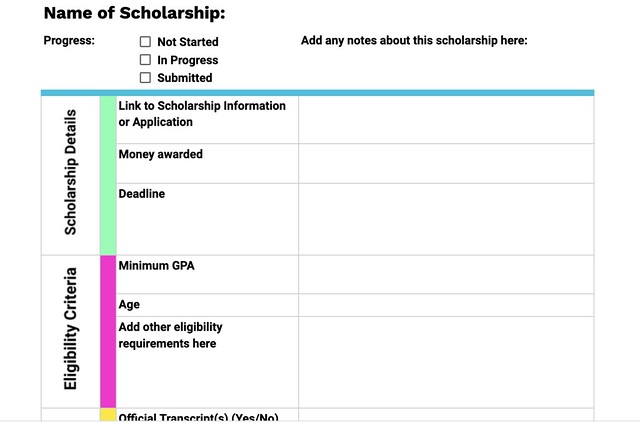
If you’ve found multiple scholarships you’re interested in applying for, you might be wondering how to stay organized with different application requirements, essays, and due dates. We can help with that! Our free scholarship application requirements tracker, both on Google Docs and Sheets, can help you stay organized during your search.
Look locally
There may be some community or religious foundations in your area that award scholarships to college students. To find them, research on your city or county’s website or social media pages, or check in with your school counselor. While local scholarships might offer less money than bigger name ones, they’re still valuable. Whether it’s $500 or $20,000, any free money you can get for college helps!
Use Get Schooled’s free scholarship resources
Scholarship Finder
Explore our database of 21,000+ scholarships to start your search! Click the image below to start searching and applying.
Our scholarship lists
Check out our hand-picked scholarship lists. They’re categorized by interest, dollar amount, and even state to connect you to even more opportunities to fund your education. We update them regularly to ensure you receive the most accurate information possible.
Essay review
Need a second opinion on your scholarship application essay? Submit it to us for free review! We’ll have it back to you within 7-10 business days with personalized, actionable feedback.
Applying for scholarships is a marathon!
There are usually fewer awards than the amount of qualified applicants per scholarship, so rejection is unfortunately a part of the process. Don’t be discouraged! Because there are so many out there, you can find great ones that you have a solid chance of receiving. The more you apply for, the higher your chances are of receiving money for college.
Applying for scholarships? Stay on top of every deadline and requirement with our free Scholarship Application Requirements Tracker. Use it to stay organized and increase your chances of winning free money for college!
Starting your scholarship search? Use our free scholarship requirements tracker to stay organized! It’s an easy way to keep track of deadlines, required materials, and submission details all in one place. Download it now to stay focused and stress-free while applying for scholarships!
To make a copy of the Google Sheets version, click the image below!
To make a copy of the Google Docs version, click the image below!
Start your scholarship search using our Scholarship Finder!
There are millions of dollars out there in scholarships right now, but knowing where and how to find legit, high-quality ones is key. To make your search easier and safer, we did research on free, trustworthy websites for you. Each of the websites listed here have been carefully vetted by the Get Schooled team to ensure they protect your personal information and show you the best college scholarships out there! Here are some of the best scholarship websites for finding money.
Websites that won’t sell your data
JLV College Counseling Scholarships
Created by a former college admissions counselor, JLV College Counseling connects students to scholarship opportunities, college application and admissions resources, and more. Scholarships are categorized by deadline, month, majors, and areas of interest. No sign up is required.
Scholarships360
Founded by two first-generation college graduates, Scholarships360 is a free-of-charge (and spam!) platform for finding up-to-date and vetted scholarships. The site also has helpful tips for finding and applying for scholarships, as well as essential FAFSA information. Sign up is required.
Going Merry
Founded by graduates of Carnegie Mellon and Stanford who relied on scholarships to fund their college education, Going Merry aims to make finding and applying for scholarships easy for students. Scholarships are broken down by specific categories, including scholarships for women, minorities, and scholarships by state. Additional financial aid and FAFSA resources are available on the site to help you understand your financial aid options. Sign up is required to apply for scholarships directly on the website.
Get Schooled
Get Schooled can help! Use our free Scholarship Finder to gain access to over 21,000 scholarships. No sign up is required! Click the image below to start your search.
Websites that may sell your data unless you request they don’t
Access Scholarships
Using Access Scholarship’s free Scholarship Search will lead you to thousands of available scholarships. Making a profile is recommended to tailor your search and match you to opportunities you’re eligible for.
Bold.org
Bold.org enables individuals and companies to create targeted scholarships, fellowships, and grants on their platform. Scholarships are broken down by state, ethnicity, education level, major, and more to make searching easy! Sign up is required to apply for scholarships.
Fastweb
Fun fact: Fastweb was the very first college scholarship search website ever! For over 30 years, their team has helped students find and apply for all kinds of scholarships, learn more about financial aid, and even help them search for part-time jobs. Sign up is required to see and apply for the over 1.5 million scholarships Fastweb offers on its database.
Scholarships.com
Scholarships.com has a large database of scholarships (over 3.7 million!), as well as free, printable resources for students preparing to apply to college. Sign up is required to begin searching.
Websites that may sell your data
These scholarship websites and databases are legit and trustworthy, but are more likely to sell your information (age, address, email, etc.) to third parties. We urge you to be intentional about the scholarships you apply for and what information you share.
Applying for scholarships? Stay on top of every deadline and requirement with our free Scholarship Application Requirements Tracker. Use it to stay organized and increase your chances of winning free money for college!
If your family’s financial circumstances changed since the tax year you reported on your FAFSA, you may be eligible to complete a change in financial circumstances appeal form once you receive your financial aid offer letters from colleges. But what does a change in financial circumstances mean, and how does this form work? We break it down!
What is a change in financial circumstances appeal form?
Many college financial aid offices offer a change in financial circumstances appeal form, which allows you to formally request that they take a deeper look at your family’s current financial situation by submitting supporting documentation. Depending on your school, the form may go by different names, such as “Special Condition/Income Adjustment Form”, “Change to Your Award Request”, or “Change of Circumstances Appeal.” Many schools have the form or outline the process on their financial aid website.
What do I do if I know my financial situation has changed while I wait for my offer letter?
If you know that your family’s financial situation has changed drastically since 2024 (the tax year the 2026-27 FAFSA uses), look at your school’s financial aid website to learn more about their appeals process. Each school will have its own process, but you may be able to submit something along with documentation while you wait to receive your financial aid offer letters.
What is a change in financial circumstances?
A change in your family’s financial circumstances can include (but is not limited to) job loss, income reduction, change in marital or dependency status, and unexpected medical expenses. If you provide documentation to your school’s financial aid office that shows your family’s financial situation underwent notable changes during the past two years, your financial aid offer could be adjusted to reflect your circumstances, potentially increasing your aid.
How to complete a change in financial circumstances appeal form
While a change in financial circumstances appeal form can differ depending on your college, here is what the process typically looks like:
Contact your college’s financial aid office to request a change in financial circumstances form and/or set up an appointment with them.
Provide documentation that shows that your family’s financial situation underwent notable changes in the past two years. Some examples of documentation include:
Signed and dated copy of their most recent tax return, including W2(s) and/or 1099(s).
Letter of separation from an employer.
Copy of an unemployment benefits statement.
Recent pay stubs.
Proof of change in marital status.
Complete the form as instructed by your college. In the instance where your dependency status changes, you may be required to update your FAFSA.
You may also be required to submit an appeal letter detailing your change in financial circumstances. We recommend using SwiftStudent—a program that helps you write a financial aid appeal letter for free—to help.
What if I don’t have the required documentation?
There are some cases in which a student may be unable to provide the financial information of a parent or guardian. Colleges may be able to grant a dependency override, which is usually a longer process and will require submitting more supporting documentation. If you are unable to provide your parent or guardian’s financial documents, get in touch with your financial aid office to explain your situation. They can support you through the process of appealing for a dependency override, which means that you may be considered an “independent” student rather than a “dependent” one.
Dependency overrides are typically available for students with complex familial situations, such as:
Those who have estranged relationships with their parents or guardians.
What to expect after submitting the form
Depending on the school, the review process for a change in financial circumstances can take weeks or months. If approved, your financial aid offer will be adjusted to reflect your current financial circumstances. If your change in financial circumstances appeal form is denied, talk to a financial aid advisor to see if any adjustments can be made to your existing offer. You can also find other forms of financial aid, such as scholarships or loans, to cover any unmet financial need.