How to Adapt Your Elevator Pitch for Any Audience (With Examples)

Last updated July 28, 2026

In this article

You’ve got an elevator pitch. Then you use it at a career fair, and it lands fine. Then you use the exact same words on an alum who offered to grab coffee, and it comes out stiff — like you’re auditioning for a job they don’t have.

That’s not a sign your pitch is bad. It’s a sign you’re giving one version of it to five different rooms.

The fix isn’t memorizing five scripts. It’s understanding which parts of your story to turn up depending on who’s listening. Below is one student’s story, told five ways.

Why one pitch doesn’t work everywhere

Every person you introduce yourself to is quietly asking a different question.

A recruiter is asking can you do the job. Someone you’re interviewing for information is asking what do you want from me. A professor is asking what do you need. A friend-of-a-friend is asking why am I on this call.

Answer the wrong question and you sound off, even if everything you said was true. Most awkward introductions aren’t caused by bad facts — they’re caused by good facts pointed in the wrong direction.

The four parts you’re working with

Whoever you’re talking to, you’re assembling the same four pieces:

  1. Who you are — your name and where you are right now.
  2. Proof — something real you’ve done that backs up your interest.
  3. Direction — where you’re headed, or what you’re trying to figure out.
  4. The ask — what you want to happen next.

The ask is the part that changes the most. It’s also the part students drop entirely, which is why so many introductions end in silence. If you leave out what you want, the other person has to guess — and usually they just say “great to meet you” and move on.

Meet Jordan

To make this concrete, here’s one student across all five situations.

Jordan is in their second year at a community college, works part-time as a pharmacy technician, and is interested in healthcare but hasn’t settled on a specific role yet. Same facts every time. Watch what moves.

Talking to a recruiter

Their question: Can you do this job?

Lead with proof and be specific about the role. Recruiters are pattern-matching against an open position, sometimes in a 90-second conversation, so make it easy.

“Hi, I’m Jordan — I’m in my second year at Metro Community College studying health sciences. I’ve been working as a pharmacy technician for about a year, so I’m used to handling patient information carefully and staying accurate under pressure. I saw you’re hiring for patient services roles this summer. Is that something I could apply for?”

Notice the pitch names a real skill from a real job, then ends with a direct question. Don’t wait to be invited to ask.

Talking to someone in a field you’re exploring

Their question: What do you want from me?

This is an informational interview, and the mistake is sounding like you’re secretly asking for a job. Make it clear you want their perspective. That’s a much easier yes.

“Hi, I’m Jordan, a health sciences student at Metro Community College. I work as a pharmacy tech, and I’m trying to figure out which direction to take in healthcare — I keep going back and forth between clinical work and something more on the public health side. I saw you’ve done both. Would you be open to 15 minutes sometime so I could hear how you decided?”

Being undecided is an asset here, not a weakness. “I’m trying to figure out X” gives the other person something specific to help with. Vague admiration doesn’t.

Talking to a professional a friend introduced you to

Their question: Why am I on this call?

Name the connection immediately — it’s why they said yes — then get to your ask quickly. Warm introductions come with goodwill and a short clock.

“Hi, I’m Jordan — Marisol mentioned you two worked together at the county health department. I’m a health sciences student and a pharmacy tech, and I’m trying to learn what public health careers actually look like day to day. She thought you’d be a good person to ask.”

Short is fine. You don’t have to earn the conversation; someone already did that for you.

Talking to a professor or mentor

Their question: What do you need?

You’re not selling here. You’re asking for guidance, so lead with the honest state of things — including the uncertainty.

“Hi Professor Reyes, I’m Jordan from your Tuesday anatomy section. I’m a second-year student and I work as a pharmacy tech. I’m trying to decide whether to go the clinical route or look at public health, and I’m not sure how to compare them. Could I come to office hours to talk it through?”

Professors and mentors respond well to specific questions. “Can I pick your brain?” is hard to say yes to. “Can I come to office hours Thursday to talk through two options?” is easy.

Writing it down: LinkedIn and cold emails

Written versions get skimmed, so front-load the important part.

LinkedIn headline — searchable, current, and directional:

Health Sciences Student at Metro Community College | Pharmacy Technician | Exploring Careers in Public Health

Cold email or DM — keep it under about 100 words, one ask, easy to say yes to:

Subject: Health sciences student — 15 minutes to hear about your path?

Hi Ms. Okafor,

I’m Jordan, a second-year health sciences student at Metro Community College and a part-time pharmacy technician. I’m exploring public health careers and found your work on community vaccination outreach.

Would you have 15 minutes in the next few weeks for a short call? I’d love to hear how you got into the field and what surprised you.

Thank you for considering, Jordan

Some people won’t answer. That’s normal, and it isn’t about you — send a few.

What never changes

The framing shifts. These don’t:

Tell the truth. Every version above is the same person with the same job and the same open question. You’re changing emphasis, not inventing a character.

Use specifics. “Pharmacy technician for a year” beats “interested in healthcare.” Concrete details are what people remember and repeat to someone else.

Keep it short. Thirty seconds out loud. Under 100 words in writing. You’re starting a conversation, not finishing it.

Always include the ask. Even a small one. Can I apply? Can we talk for 15 minutes? Can I come to office hours?

Say it out loud before it counts. It always sounds different in your mouth than in your head. Practice on a friend, or run through it with our Interview Coach and Career Skills Coach.

Want feedback on your own version before you use it? Connect with a Get Schooled Advisor. It’s free, and you can bring a rough draft — that’s what it’s for.

Keep going

How to Figure Out What Career Is Right for You

Last updated August 6, 2026

In this article

Most career advice starts in the wrong place. It hands you a list of high-paying jobs, or a quiz that spits out “forensic accountant,” and waits for you to react.

But a career isn’t something you get assigned. It’s something you build out of what you’re good at, what you care about, and what your life realistically needs to look like. All three are about you, which means you’re the first thing to research!

This article is the starting point to walk you through taking an honest inventory of yourself, and then turning that into careers you can actually look up, ask about, and try.

Why career exploration should start with you

It’s tempting to skip this part. Reflecting on yourself feels slower than scrolling a list of careers, and less productive.

It isn’t. Here’s what starting with yourself gets you:

It cuts a huge field down fast. There are thousands of jobs out there and you can probably name thirty. Knowing that you need to be around people, or that you’d rather be judged on results than on hours, eliminates entire categories in one move.

It gives you language. Once you can say “I want work where I solve problems for people face to face,” you can search better, ask better questions, and write a much stronger resume and cover letter. Employers respond to candidates who know what they’re looking for.

It makes you harder to talk out of things. When you understand why a path fits you, other people’s opinions about it carry less weight, including the well-meaning ones.

Skipping straight to job listings means making a big decision with no information about the most important variable in it.

Four questions worth answering first

You don’t need a personality test. You need honest answers to four questions.

Write them down. This matters more than it sounds like it does; you literally use a different part of your brain when you write things down.

1. What am I actually good at?

Not “what’s my best subject.” What do people come to you for? What do you pick up faster than the people around you? What part of a group project do you end up owning because you’re the one who can do it?

Count the things that don’t look academic. Calming down an upset customer, keeping a group organized, fixing something without instructions, explaining a concept until it finally clicks for someone, those are real skills that employers pay for.

2. What holds my attention?

What do you lose track of time doing? What do you read about, watch, or argue about when nobody assigned it?

An interest isn’t a career plan by itself. But it’s a strong signal, because it tells you what you’ll still care about on an ordinary Wednesday three years in.

3. What matters to me?

This is the values question, and it’s the one people skip. Do you need to feel like your work helps someone? Do you want recognition, or do you want to be left alone to do the work? Right now, is stability worth more to you than excitement, or the other way around?

Practical things belong on this list too. Wanting to earn enough to support your family holds real value, not misplaced priorities.

4. What does my life need to look like?

Schedule, location, how much training you can afford, how long you’re willing to be in school, whether you’re able to move. These are constraints, and naming them isn’t giving up on anything, it’s how you build a plan that survives contact with your actual life.

Ready to go deeper on these? Our Self-Exploration Worksheet takes you through them in a structured format.

Reflection that stays in your notes app doesn’t move you forward. The goal is to convert what you learned into terms you can look up.

Read back over your four answers and pull out the patterns, not job titles, but conditions. Something like: good at explaining things, care about health, need predictable hours, can’t do eight years of school.

Now search deeper:

  • The U.S. Bureau of Labor Statistics’ Occupational Outlook Handbook lists hundreds of careers with what they involve, what they pay, what training they require, and whether the field is growing.
  • O*NET OnLine lets you search by interests and skills rather than by job title.

That example above might surface respiratory therapist, health educator, medical assistant, or dental hygienist. Solid careers that plenty of students have never had described to them. You’ll find options you didn’t know existed, which is exactly why the order matters.

When you have a few worth investigating, our Know the Landscape series covers how those fields and their hiring processes actually work.

Test what you find in the real world

Reflection tells you what you think you want. Only experience tells you whether you’re right and want to continue.

Once you’ve got two or three fields worth exploring, get close to them:

  • Talk to someone who does the job. Ask what a normal day looks like, what surprised them, and what they’d do differently. Our The Way: Career Stories to Find Your Way series is a good place to start listening.
  • Try a small version of it. A volunteer shift, a free online course, a one-day job shadow, or a part-time job in that kind of environment.
  • Pay attention to your reaction, especially the negative ones. “I hated how quiet it was” is genuinely useful information about you.

Then bring what you learned back to your four answers and revise them. Reflect, research, try, revise. That loop is career exploration. It isn’t a one-time decision you make and then live with.

Expect your answers to change

The person you are right now is not the person you’ll be in five years. Your skills will grow, your priorities will shift, and jobs that don’t exist yet will exist by the time you’re looking.

So come back to these four questions, after a first job, after a class that surprised you, after something goes badly. The questions stay the same. Your answers won’t, and that’s a sign the process is working.

Start with one question today

Pick one of the four questions and write your answer down. Not a plan, not a major, not a five-year timeline. One honest answer.

That’s how this starts.

Want a second opinion on what you’re seeing in your own answers? Connect with a Get Schooled Advisor. It’s free, it’s judgment-free, and “I don’t know where to start” is a completely fine place to begin.

Keep going

What If You Don’t Have a Passion? Here’s What to Do Instead

Last updated August 7, 2026

In this article

Somewhere along the way, someone probably told you to follow your passion. Maybe it was a graduation speech, or a teacher, or a poster in a hallway.

It’s a nice sentence. It’s also unhelpful if you don’t have one — and a lot of people don’t. If you’ve been quietly assuming everyone else got handed a calling and you got skipped, this article is for you.

The short version: not having one clear passion is normal, changing your mind is normal, and neither one means you’re behind.

“Follow your passion” assumes you have one

The advice only works if a passion is something you find sitting there fully formed, waiting for you to notice it. Under that assumption, if you haven’t found yours, the problem must be you… you didn’t look hard enough… you’re not self-aware enough…

That’s not how it works for most people. Interests are usually built, not discovered. They start as mild curiosity, and they get stronger as you learn more, get better, and start to see how the thing connects to other things you care about.

Research backs this up. Psychologists studying how people relate to their interests have found that students who believe passions are developed stick with new subjects longer when they get hard. While students who believe passions are found tend to conclude that difficulty means it wasn’t the right fit, and quit.

So the pressure you feel to already know isn’t just uncomfortable. It’s working against you.

Passion usually shows up after you get good at something

Think about anything you’re genuinely into right now – a sport, a game, an instrument, a subject. Were you passionate about it the first day?

Almost certainly not. The first day you were bad at it. What made it interesting was getting less bad: understanding the rules, seeing your progress, being trusted with more.

Work follows the same pattern. People who love their jobs usually didn’t walk in loving them. They got competent, got useful, got some autonomy, and the feeling followed. Which means the practical move isn’t to search harder for the thing you already love — it’s to get good at something you’re curious about and see whether the feeling develops.

This is also good news financially. It means you don’t have to choose between “meaningful” and “pays the bills.” A stable job you become excellent at can turn into work you care about. That happens all the time.

Changing your mind is the norm, not a failure

Here’s the part nobody tells you: even the people who did pick something confidently change course.

Within three years of starting college, about 30% of students who had declared a major had changed it. And roughly 1 in 10 changed more than once (National Center for Education Statistics). That’s just the students who declared early enough to switch.

It keeps going after graduation. As of January 2024, the median U.S. worker had been with their current employer for 3.9 years (Bureau of Labor Statistics). Most people are not doing one thing forever.

So when you picture the adults around you as having chosen once and stayed, you’re usually looking at a story that’s been tidied up in the retelling. Ask a few of them directly and you’ll hear about the detours.

What to do instead of waiting for a lightning bolt

If passion is built, then your job right now is to run cheap experiments and pay attention to the results.

Follow curiosity, not certainty. You don’t need to love something to look into it. Mild interest is enough of a reason to take a class, watch a documentary, or read about how a field works.

Get close to real work. A volunteer shift, a summer job, a one-day shadow, a free online course. An afternoon of doing something teaches you more than a week of reading about it.

Build skills that transfer. Communication, problem-solving, adaptability, working with people who aren’t like you — these pay off in every direction you might eventually go, which makes them a safe bet while you’re undecided. Our Build Your Career Skills series breaks these down.

Write down what you notice. Two columns: what felt good, what didn’t. “I liked being on my feet.” “I hated waiting for someone to tell me what to do next.”

If you want a structured version of this, start with How to Figure Out What Career Is Right for You and the Self-Exploration Worksheet.

How to change your mind well

Changing direction isn’t free, so it’s worth doing deliberately rather than in a panic.

Name what’s actually wrong. “I don’t like this” is worth unpacking. Is it the subject, the workload, one bad professor, one bad manager, or the fact that you’re exhausted? Those lead to very different decisions.

Look at the cost honestly. Switching a major in your first year is cheap. Switching in your senior year may add time and money. Ask an advisor to walk you through what a change would actually mean — before you decide, not after.

Take the parts that transfer with you. Two years in a program you left isn’t wasted. You learned to write, meet deadlines, handle a hard subject, and probably discovered something real about yourself. All of that comes along.

Change toward something, not just away. Leaving because something is wrong is a fine reason to start looking. It’s a weak reason to pick what’s next. Do a little exploring before you commit again.

You’re not behind

There’s no schedule for this. The idea that you should have it settled by 17, or 20, or 22, isn’t based on anything real — plenty of people find their footing much later and do great work.

What you can do right now is stay curious, try things at small scale, and notice your honest reactions. That’s not a fallback plan. That’s the actual method.

Feeling stuck on what to try first? Connect with a Get Schooled Advisor. It’s free, it’s judgment-free, and “I don’t know what I like yet” is a perfectly good place to start.

Keep going

Self-Exploration Worksheet to Discover a Career

Last updated June 25, 2026

In this article

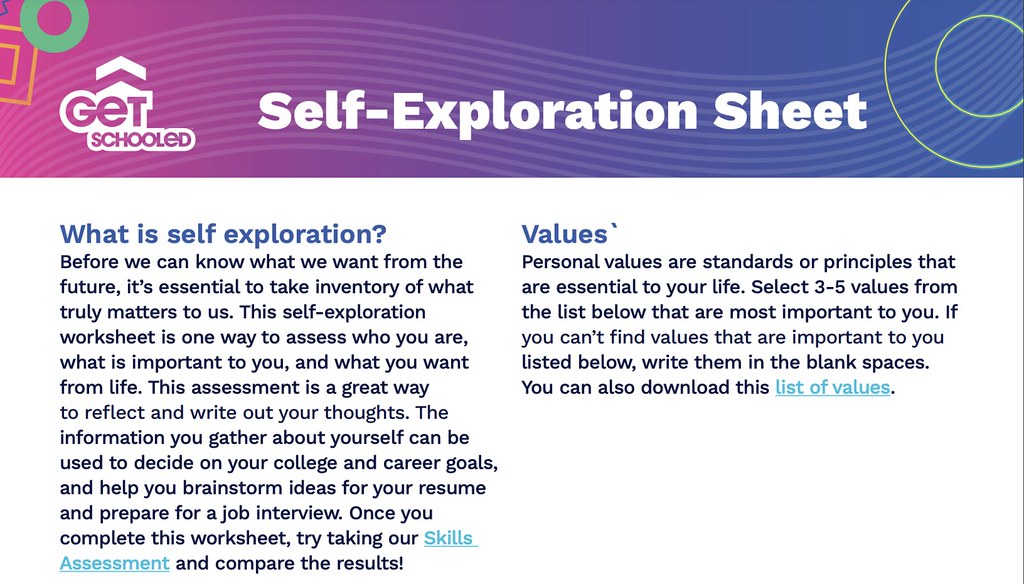
Before you can know what you want from the future, it’s essential to take inventory of what truly matters to you. This self-exploration worksheet is a way to assess who you are, what’s important to you, and what you want from life. This assessment is a great way to reflect and write out your thoughts.

Click the image below to download and fill out our self-exploration worksheet!

Screenshot of the Self-Exploration Worksheet- Self-Exploration Worksheet

Do you have any questions? Connect with a Get Schooled Advisor.

Keep going

How to Build Your Professional Brand

Last updated February 26, 2026

In this article

For early career professionals and job-seekers, knowing how to articulate your professional journey to employers can help you stand out. Having a strong professional brand can help you identify the right professional opportunities and make stronger career moves. In this article, we’ll show you how to build and showcase your professional brand. 

What is a professional brand?

A professional (or personal) brand is the story you tell about yourself to potential employers and other working professionals. It communicates your values, skills, professional interests, and what you bring to a new job or opportunity. It can show up on your resume, LinkedIn profile, job applications, and even in conversations with your network or mentors. Spending time thinking about how to tell your story in a professional context is important. Doing so will allow you to intentionally shape the story you tell employers so they can see how the opportunity you’re going for fits with your overall career trajectory and goals. When you are thoughtful and intentional about how you tell your story, it can help employers understand why you are the right fit for the position you’re applying for.

Start by creating a brag sheet 

You might be thinking: How does one even know what their personal brand is? Getting to this will take some self-reflection around your values, goals, and skills. A great starting point is creating your own brag sheet. Most often, brag sheets are used to help references give job or college recommendations, but they’re useful for anyone beginning their career journey. A brag sheet is similar to a resume; it’s a place where you can list all of your accomplishments, work and academic experience, leadership skills, extracurricular activities, and employment or volunteer history. Taking a moment to create a brag sheet can help you reflect on your accomplishments and what’s necessary to highlight to employers. 

Work on your elevator pitch

After reflecting on your personal and professional experiences, you can start translating them into an “elevator pitch.” An elevator pitch is a short summary that explains who you are to a prospective employer or professional. It’s historically called an elevator pitch because it should be quick enough to say during the duration of an elevator ride. Elevator pitches are often used at networking events and job interviews. To help shape your pitch, consider these questions:

  • Who are you?
  • Why are you talking to them?
  • What are you interested in?
  • Why are you qualified?
  • How can they help you?

Here is an example of how to structure your pitch: 

“Hi, I’m [name], a marketing major at Scholar University and an early-career marketing professional. I found your company on LinkedIn and reached out because your work in [their field] aligns with the roles I’m exploring. I’m building skills in branding, digital marketing, and consumer behavior in my courses and I am preparing for a summer 2026 marketing internship. I’d really appreciate it if you had 15-20 minutes for an informal informational interview. I’d love to hear about your experience breaking into the marketing industry. Let me know if you have the capacity.”

Personal brand and social media 

When building your professional brand, it’s important to consider your social media presence. You’ll want to make sure any public profiles align with the story you’d tell to employers and members of your network in person to remain consistent. Many employers search applicants’ names online as part of the hiring process, so anything that’s public online, including your personal social media accounts, may be considered as part of your application. Take a look at your social media and consider removing anything that might hurt your credibility. Additionally, on professional networking sites like LinkedIn, take a moment to update your headline, summary, and experience to match your professional brand. Be sure to highlight coursework, projects, clubs, part-time jobs, or achievements that represent who you are professionally.

Why your professional brand matters

Knowing how to build your professional brand matters because the job market, internships, and college applications are competitive. When you have a clear brand, you make it easier for employers, professors, and mentors to understand what you want, what you believe, and how you can contribute.

Do you have any questions about building your personal brand? Connect with a Get Schooled Advisor.

Keep going